article · draft
A short history of the digital twin
Where the idea and the name came from: Apollo's simulators, Gelernter's Mirror Worlds, Grieves and NASA, and the step from spacecraft and factories to cities and the built environment.
The idea of a running copy of a real thing, kept up to date with what happens to the original, is older than its name. A 2021 NASA keynote by B. Danette Allen says the idea was born at NASA in the 1960s, as a "living model" of the Apollo mission.1 After the oxygen tank explosion on Apollo 13, NASA used several simulators to work out what had failed, and extended a physical model of the vehicle with digital parts.1
The idea had been imagined for places before it had its name. In Mirror Worlds, published in 1991, the Yale computer scientist David Gelernter imagined looking at a screen and seeing an image of your city with its traffic moving.2 Or the screen might show the state of a whole company at this second.2 Any citizen could look in, for example to explore how the local schools were doing.2 The book also explains how such a program could be built with the technology of the day.2 The wiki has an entry on the book: Mirror Worlds.
Two accounts of virtual cities date from around 2000. A chapter by Risto Linturi, Marja-Riitta Koivunen and Jari Sulkanen in the 2000 Springer collection Digital Cities is titled "Helsinki Arena 2000 - Augmenting a Real City to a Virtual One".3 In 2002 Toru Ishida wrote an article titled "Digital city Kyoto" in Communications of the ACM.4
The name came from manufacturing and aerospace. Michael Grieves writes that he introduced the concept of a virtual, digital equivalent to a physical product in 2003, in his University of Michigan executive course on product lifecycle management.5 His model had three parts.5 There is the physical product in real space and the virtual product in virtual space, and there are the links of data and information that tie the two together.5 He writes that he introduced the term "Digital Twin" in his book Virtually Perfect, and that he attributed it to John Vickers of NASA, with whom he works.5 Open Library dates that book to 2011.6
At NASA the term appears in a November 2010 draft roadmap for modelling, simulation, information technology and processing, written by a team chaired by Mike Shafto.7 It defines a NASA digital twin as a simulation of a vehicle or system that combines physical models, sensor updates and fleet history "to mirror the life of its flying twin".7 The roadmap lists four uses.7 They are flying a mission in simulation before launch, following the real flight as it happens, diagnosing the cause of a serious fault or damage, and studying changes to the mission that were not considered when the vehicle was designed.7 The April 2012 version of the roadmap keeps the same definition.8
Also in April 2012, Edward Glaessgen of NASA and D. S. Stargel of the Air Force Office of Scientific Research presented a paper on the digital twin to a structures conference in Honolulu, in a session given over to the subject.9 Their definition speaks of an "as-built" vehicle: the twin models the vehicle as it was made, including its defects and fabrication anomalies.9 A footnote says the paradigm was originally conceived by the Defense Sciences Office at DARPA.9 They list the NASA roadmap among their references.9 Grieves and Vickers later wrote a chapter on the digital twin and unpredictable, undesirable emergent behaviour in complex systems, which Springer published in 2016.10
In Britain in 2018, the Centre for Digital Built Britain and the Digital Framework Task Group published the Gemini Principles, named after the Latin for twins.11 The paper is about the built environment and its infrastructure.11 It defined a digital twin as "a realistic digital representation of assets, processes or systems in the built or natural environment".11 It said that what sets a twin apart from other models is its connection to the physical thing it twins.11 It also proposed a national digital twin.11 This would not be one huge model of the entire built environment.11 It would be many twins, each kept by the owner of the assets it models, joined by securely shared data only where that delivers value.11 One of its examples is a new wastewater treatment plant.11 By bringing together the twins of the water, energy and transport sectors, its effect on power demand and on traffic on local roads could be modelled.11 The paper notes that NASA had run complex simulations of spacecraft for decades.11
City-scale twins now include heritage work. In 2025 a team from the University of Bradford, with co-authors from the city council and elsewhere, described Virtual Bradford.12 They built it in partnership with the council and call it one of the first open-data city-scale twins at that level of detail.12 It covers the city centre, including several conservation areas and multiple listed buildings.12
The term is still used loosely. A 2020 paper by Louise Wright and Stuart Davidson says it is applied in many different ways, often without saying how a twin differs from a model.13 They describe the basic parts of a twin as essentially a model and some data.13 This wiki uses the phrase in that broad sense, for models and simulations of places; see What is a digital twin?.
is about this entity
-
A computational representation of a real object, place or system, linked to information about its real-world counterpart.
refers to this entry as a source
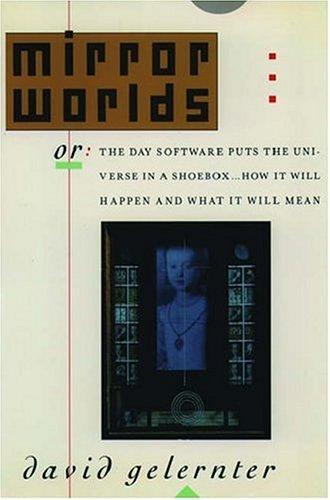
David Gelernter's 1991 book that first described software models of real places and institutions, fed by live data, that anyone could look into; the idea the digital twin of a place grows from.
Tags: history, digital twin, mirror world, NASA, product lifecycle management, national digital twin, city