Ontologies
How the data of a place is cut into things and relations a model can reason about.
Between the data and the engine sits a decision about what the things are. A river model's world is reaches and flows; a city model's world is buildings with heights and uses; an agent-based model's world is agents and rules. These choices are the model's ontology, and most engines carry one without saying so. Joining two models is mostly the work of reconciling two of them.
The choices matter because the world does not arrive in pieces. A "thing" is a cluster of tightly entangled relationships that is useful to name because it is roughly separate from other clusters: a dog, a watershed, a government. People are very good at recognising such clusters, and the categories they form are graded rather than sharp, with some members more typical than others (prototype theory; George Lakoff, Women, Fire, and Dangerous Things). John Muir, in My First Summer in the Sierra: "When we try to pick out anything by itself, we find it hitched to everything else in the universe." A model has to pick things out anyway. See the term entry Ontology.
This shelf holds the data models and standards that twins are built on, the papers that propose ways to order the subsystems of a place or a planet, methods for building a vocabulary up into a knowledge graph in order (reviewed here: the book Ontology Pipeline), and tools that build or discover vocabularies. It is the thinnest layer of the stack on this site and in the field, and the one where new entries are most welcome.

Open-source Python library by Yuta Sato and colleagues that turns buildings, streets, transit feeds, origin–destination matrices, zones and points of interest into graphs for network analysis in NetworkX and for graph neural networks in PyTorch Geometric.
Cities & placesMovement & logistics open sourceAPIopen participation
-
A JSON encoding of the OGC CityGML data model for 3D city models, with open tools to convert, validate, view and edit files; version 2.0 is an official OGC standard.
Cities & places open sourceopen participation
 A just world on a safe planet: Earth-system boundaries, translations, and transformations article draft
A 2024 report in The Lancet Planetary Health by Gupta and colleagues for the Earth Commission, on Earth-system boundaries, their translations and transformations. The Commission's safe and just boundaries cover Earth systems including biodiversity, land, freshwater, nutrients, climate and air pollution.

An experiment by Anselm Hook in which a machine reads the news, finds the things each story is about, decides what kinds of things they are, and lets the vocabulary of kinds and parts grow from the text; the things on a map over time, with the source code public.
People & society open sourceopen participation

An open specification from Google Cloud's Data Cloud team for keeping curated knowledge as a directory of markdown files with YAML frontmatter and ordinary links between them, so that people, AI agents and other tools can read the same files without a translation layer.
Cities & places open sourceopen datano APIopen participation
- Conceptualizing Small and Medium-Sized Smart Cities in the Mediterranean Region: An Ontological Approach article draft
A 2019 paper in the International Journal of E-Planning Research by Panagiotopoulou, Kokla and Stratigea of the National Technical University of Athens that extends an existing smart city ontology with concepts and relationships drawn from small and medium-sized Mediterranean cities.
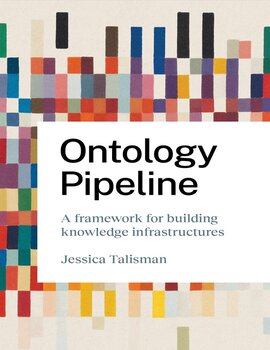
Jessica Talisman's 2026 book from Technics Publications sets out a method for building a knowledge system in six stages, from controlled vocabulary through taxonomy and thesaurus to ontology and knowledge graph, with a browser Studio and a SKOS editor beside it; read here for what it offers someone modelling a place.
-
A 2021 paper in Earth System Dynamics by Donges and colleagues that proposes three taxa of modelled subsystems, biophysical, socio-cultural and socio-metabolic, and a scheme for classifying the interactions between them.
Weather & climateLiving systems open source