tool · draft
Agents.jl
Open-source Julia library from JuliaDynamics for agent-based models, with grids, networks, continuous space and OpenStreetMap road networks, and both step-by-step and event-driven time.
People & societyCities & places
What is reusable: open sourceopen dataAPIopen participation MIT
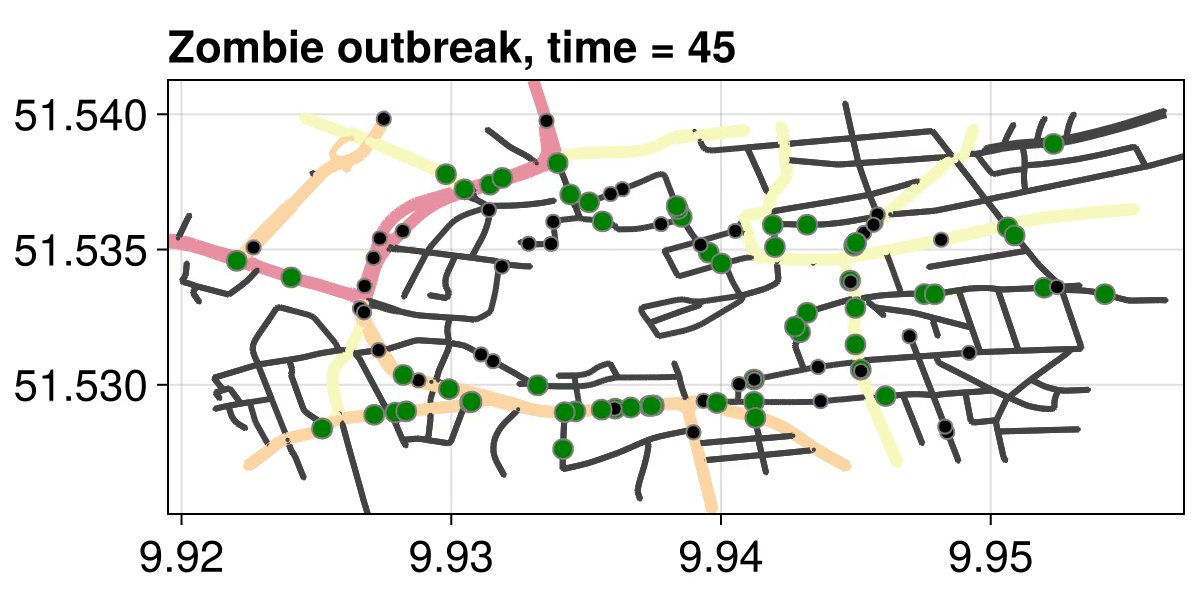
Zombie outbreak on an OpenStreetMap street network, from the Agents.jl examples. JuliaDynamics, MIT licence.
Agents.jl is a library for writing agent-based models in Julia, a programming language.1,2 An agent-based model is a simulation of individual agents that each react to their surroundings, including other agents, by a set of rules.1 The library supplies the common parts: agents, several kinds of space, schedulers that decide which agent acts when, automatic collection of results into a table (a DataFrame), batch runs and distributed computing.1 It belongs to the JuliaDynamics organisation of scientific software projects.1,2
Space can be a network, a regular grid, continuous space or a real road network from OpenStreetMap, with road speed limits, searches for nearby agents and roads, and route finding.1 Time can advance in fixed steps or, for continuous-time models, by an event queue.1 Version 7 added an experimental layout for faster runs and a model type that links agent-based models with reinforcement learning, in which agents learn by trial and reward.1 Plots, videos and interactive apps come through Julia's Makie graphics packages.1 The project says its models take much less code than in other open-source frameworks and that it ran faster than every framework it compared itself with.1
It installs from Julia's package manager and is free under the MIT licence.1,2 The paper to cite is Datseris, Vahdati and DuBois, "Agents.jl: a performant and feature-full agent-based modeling software of minimal code complexity", in the journal SIMULATION, 2022.2 Version 7.1.0 was released in October 2026.4
For someone modelling a place, the OpenStreetMap space lets agents travel real streets. The documentation's example spreads a zombie outbreak through a city's street network, with agents planning random routes and moving along roads, and the project points to a simulation of the whole city of Chicago.1,3 The same pattern fits commuters, deliveries or evacuations. Mesa does the same job in Python, and NetLogo is a visual, lower-code start.
- form
- open-source Julia library
- group
- Agents and system dynamics
- homepage
- https://juliadynamics.github.io/Agents.jl/stable/
- licence
- MIT
- cost
- free
does a similar job
-
Open-source Python library for building agent-based models, with grids, networks, data collection and a browser view; Mesa-Geo adds maps, so agents can live in real geography loaded from GIS files.
open sourceopen dataAPIopen participation
-
Free, open-source environment for agent-based modelling, created by Uri Wilensky and developed at Northwestern University; widely used in teaching and research, with a desktop version and NetLogo Web in the browser.
open sourceopen dataAPIopen participation
alternative to
-
University of Sheffield library that runs very large agent-based models on NVIDIA graphics processors, from C++ or Python; AGPL-3.0, or a commercial licence.
open sourceopen dataAPIopen participation
Tags: agent-based, Julia, simulation framework, OpenStreetMap