Warming thresholds of climate tipping elements
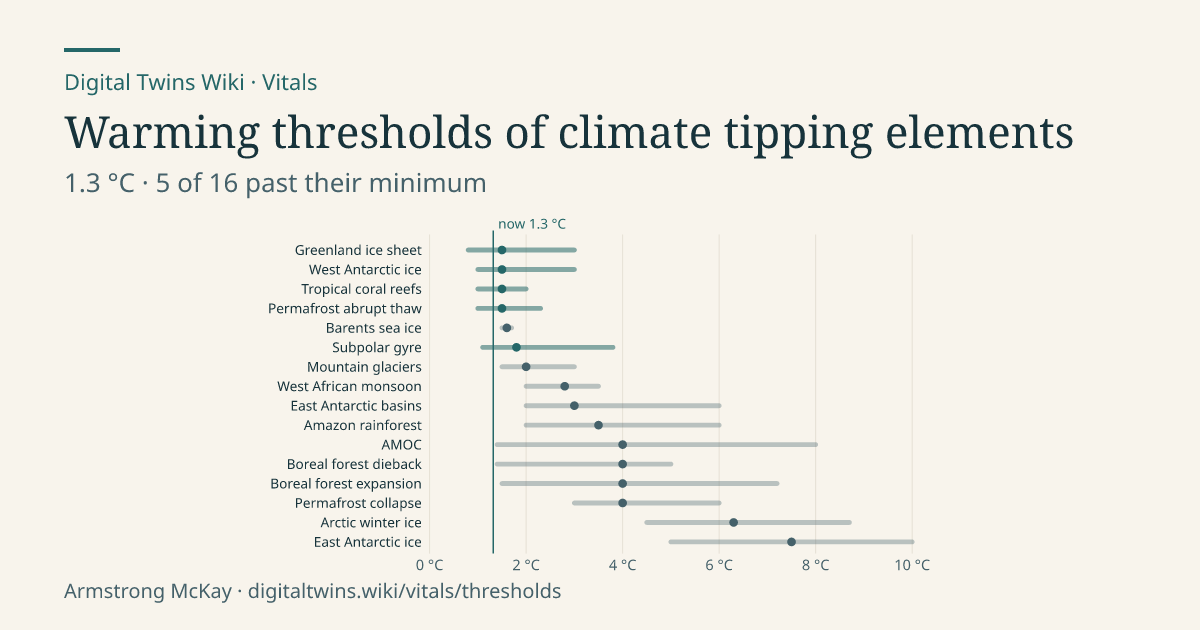
Global warming is 1.3 °C; 5 of 16 past their minimum of the tipping elements in Armstrong McKay et al. (2022). Each bar runs from the minimum to the maximum estimated threshold.
Warming thresholds of climate tipping elements
1.3 °C · 5 of 16 past their minimum
Bars run from the minimum to the maximum estimated threshold, the dot at the central estimate; highlighted bars have their minimum already passed, the vertical line is today's warming from the global temperature series. Armstrong McKay, D. I., Staal, A., Abrams, J. F., Winkelmann, R., Sakschewski, B., Loriani, S., Fetzer, I., Cornell, S. E., Rockström, J. and Lenton, T. M. (2022). Exceeding 1.5°C global warming could trigger multiple climate tipping points. Science 377(6611), eabn7950. https://doi.org/10.1126/science.abn7950 · read from this copy · json · Paper: 'Copyright © 2022 the authors, some rights reserved; exclusive licensee American Association for the Advancement of Science. No claim to original US government works.' Repository reuse terms: https://www.uu.nl/en/university-library/license-and-reuse-conditions · Literature-based expert estimates of the global warming at which each element tips: the paper calls crossing a tipping point 'possible' beyond its minimum temperature threshold and 'likely' beyond its central estimate, with the maximum the top of the estimated range.
Citations: Armstrong McKay, D. I., Staal, A., Abrams, J. F., Winkelmann, R., Sakschewski, B., Loriani, S., Fetzer, I., Cornell, S. E., Rockström, J. and Lenton, T. M. (2022). Exceeding 1.5°C global warming could trigger multiple climate tipping points. Science 377(6611), eabn7950. https://doi.org/10.1126/science.abn7950