tool · draft
Nextstrain
Open-source tracking of how pathogens evolve and spread, rebuilt from shared genome sequences as they arrive; live views of H5N1 bird flu, measles, mpox, Ebola, SARS-CoV-2 and many more.
People & societyLiving systems
What is reusable: open sourceopen dataAPI unknownopen participation AGPL-3.0
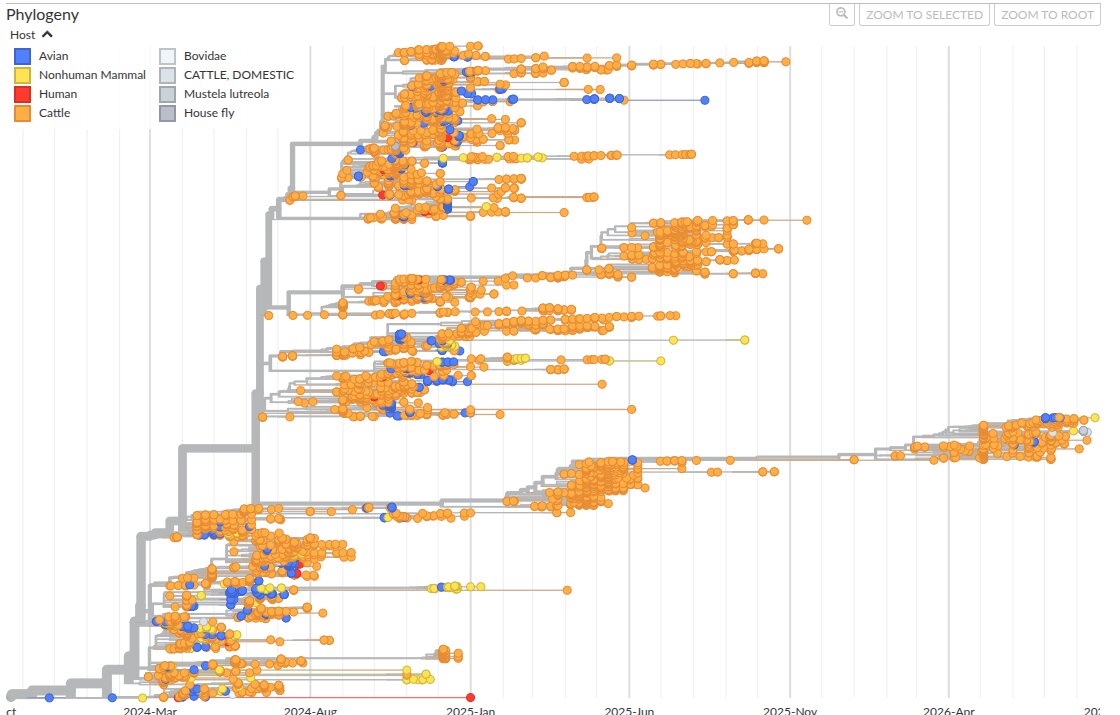
Nextstrain takes the genome sequences that labs around the world share for a virus or bacterium and turns them into a family tree and a map, updated as new sequences come in.1,2 Each tip of the tree is one sampled infection; branches that share mutations share an ancestor, so the tree shows which outbreaks are connected, roughly when a lineage jumped, and where it travelled.2 Its front page lists continually updated views for H5N1 avian influenza, seasonal flu, measles, mpox, Ebola, tuberculosis, West Nile virus, SARS-CoV-2 and many more.1
The picture is the full-genome view of the H5N1 outbreak in North American cattle, coloured by host: cattle in orange, birds in blue, other mammals in yellow and humans in red.5 When captured it showed 5,647 genomes sampled between November 2023 and August 2026, maintained by Louise Moncla and the Nextstrain team.5 The avian-flu build splits the cattle outbreak (genotype B3.13, from 2024) from the separate D1.1 jumps into cattle in 2025, and builds per-segment trees for H5N1, H5NX, H7N9 and H9N2.4
Augur is the pipeline that filters the sequences, aligns them and builds the trees.2,6 Auspice draws them in the browser. Nextclade places a single sequence on a reference tree inside the browser, and Nextstrain Groups lets labs and health agencies publish their own analyses on the site.1 The code is under the GNU Affero General Public License, and screenshots may be reused under CC BY 4.0 with credit to nextstrain.org.3 The site's copyright line names Trevor Bedford and Richard Neher; the core team page lists ten people.3
For someone modelling a place, Nextstrain is the measured side of an epidemic. Simulators such as OpenABM-Covid19 and MATSim EpiSim run what-ifs on a synthetic population. A tree like this one is what those what-ifs have to answer to. It can also be the first record that a shock from outside the model has arrived, as when a bird virus turned up in dairy herds.
- form
- open-source pipelines (Augur), web viewer (Auspice) and a public site
- group
- People and populations
- homepage
- https://nextstrain.org/
- licence
- AGPL-3.0
- cost
- free
Tags: pathogen genomics, phylogenetics, epidemic surveillance, H5N1, bird flu, public health