person · draft
Hans Joachim Schellnhuber
German physicist who founded the Potsdam Institute for Climate Impact Research and led it from 1992 to 2018; known for work on tipping elements in the climate system.
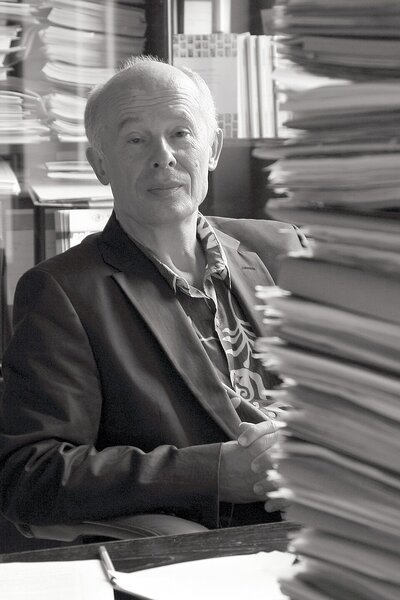
Foto Hollin, Wikimedia Commons, CC BY-SA 3.0.
Hans Joachim "John" Schellnhuber, born 7 June 1950, is a German physicist.1 He took a doctorate in theoretical physics at the University of Regensburg in 1980 and was a postdoctoral fellow at the Institute for Theoretical Physics in Santa Barbara; from solid state physics he moved into complex systems and nonlinear dynamics.1,2 He was the founding director of the Potsdam Institute for Climate Impact Research, which he led from 1992 to 2018, and director emeritus until 2024.2 Since December 2023 he has been Director General of the International Institute for Applied Systems Analysis (IIASA) in Laxenburg, Austria.2 He has also been research director of the Tyndall Centre in England and an external professor at the Santa Fe Institute.1,2
Wikipedia credits him with helping to create the analysis of tipping elements in the climate system, the "burning embers" diagrams of risk and the budget approach to emissions.1 In 1995 he proposed the 2 °C guardrail for global warming, later adopted by Germany, the European Union and, after Copenhagen in 2009, governments worldwide.1 He initiated the Inter-Sectoral Impact Model Intercomparison Project (ISI-MIP), in which more than 30 research teams compare their simulations of climate impacts on water, floods and crops.1 Since 2019 his work has turned to the built environment and regenerative architecture, and he founded Bauhaus Earth.2
He appears in the entry on PIK.
- affiliation
- International Institute for Applied Systems Analysis (IIASA)
- role
- climate scientist
- homepage
- https://www.pik-potsdam.de/members/john
Tags: climate, tipping points, complex systems