person · draft
Murray Gell-Mann
Physicist who won the 1969 Nobel Prize for classifying elementary particles, proposed quarks, and in 1984 co-founded the Santa Fe Institute and its study of complex systems.
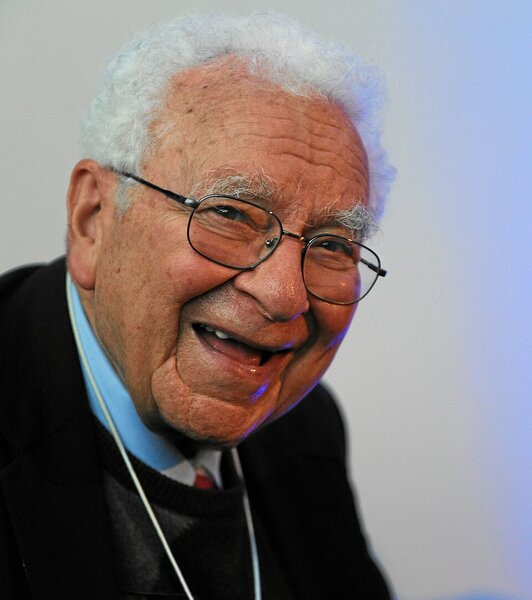
World Economic Forum, Wikimedia Commons, CC BY-SA 2.0.
Murray Gell-Mann (15 September 1929 to 24 May 2019) was an American theoretical physicist.1 He won the 1969 Nobel Prize in Physics, while at Caltech, "for his contributions and discoveries concerning the classification of elementary particles and their interactions". He proposed that the particles then observed are made of smaller building blocks, quarks.1
In 1984 he was one of several co-founders of the Santa Fe Institute, set up to study complex systems across disciplines.3 SFI's president David Krakauer has said that he gave complexity science "the intellectual foundations necessary for significant future discoveries", and in 2015 the institute named its main building after him.2 Outside physics he was drawn to linguistics, among other fields, and with S. A. Starostin he set up the Evolution of Human Languages project at SFI.3 His popular book The Quark and the Jaguar: Adventures in the Simple and the Complex came out in 1994.3 He died at his home in Santa Fe.1,3
The Santa Fe Institute entry tells how David Pines brought him into the group around George Cowan that founded the institute.
- affiliation
- Santa Fe Institute
- role
- theoretical physicist
belongs to this organization or group
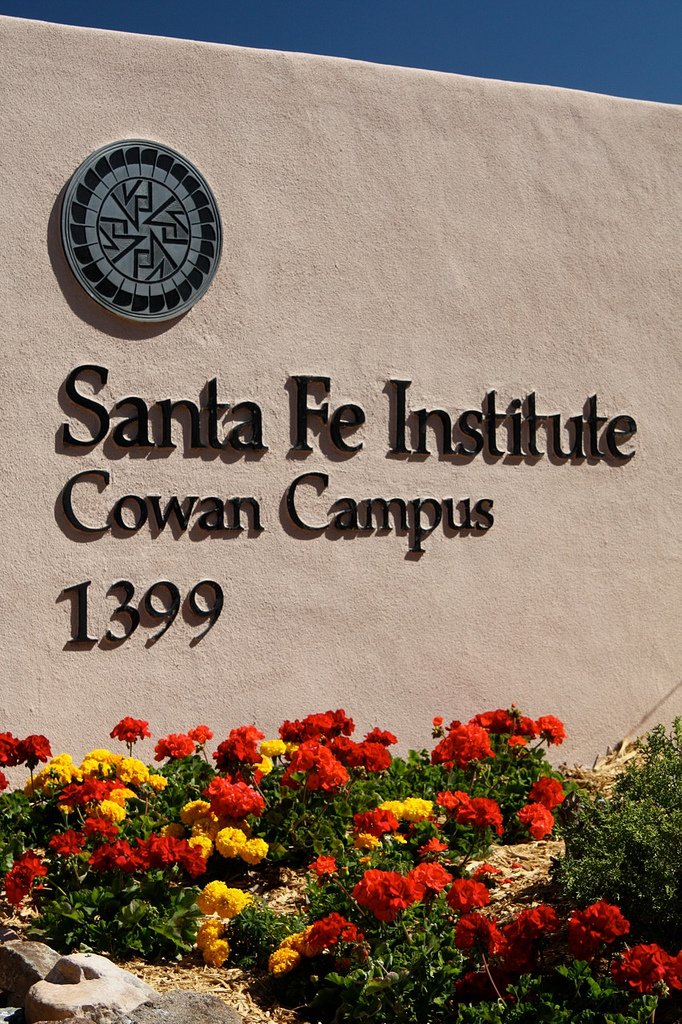
Nonprofit centre in Santa Fe, New Mexico, founded in 1984 to study complex systems; its free Complexity Explorer courses teach agent-based modelling and scaling.
Tags: complexity, history, physics