person · draft
Robert Axtell
Computational social scientist at George Mason University who built Sugarscape, the model behind Growing Artificial Societies (1996), with Joshua Epstein.
Robert L. Axtell is Professor of Computational Social Science at George Mason University, affiliated with its Center for Social Complexity.2 His own page says he chairs the Department of Computational Social Science, part of the Krasnow Institute for Advanced Study, co-directs the Computational Public Policy Lab, and has been an external professor at the Santa Fe Institute for many years.1 He took an undergraduate degree at the University of Detroit and an interdisciplinary PhD at Carnegie Mellon University in 1992.1,2
He met Joshua Epstein as a graduate student and joined him at the Brookings Institution in 1992; he left for George Mason in 2007.3 At Brookings he was a fellow in foreign policy studies and then a senior fellow in economic studies and governance studies, and with colleagues created the Center on Social and Economic Dynamics.1 While there he also taught microeconomics and agent-based computing at several universities.1 In the 2013-14 academic year he was visiting professor of complexity economics at Oxford.1
Axtell developed Sugarscape. It is the model at the centre of Growing Artificial Societies (1996), the book he wrote with Epstein.3 He describes the book as an early statement that social science can be done with software agents.1
- affiliation
- George Mason University
- role
- computational social scientist
- homepage
- https://css1.gmu.edu/~axtell/Rob/Home.html
belongs to this organization or group
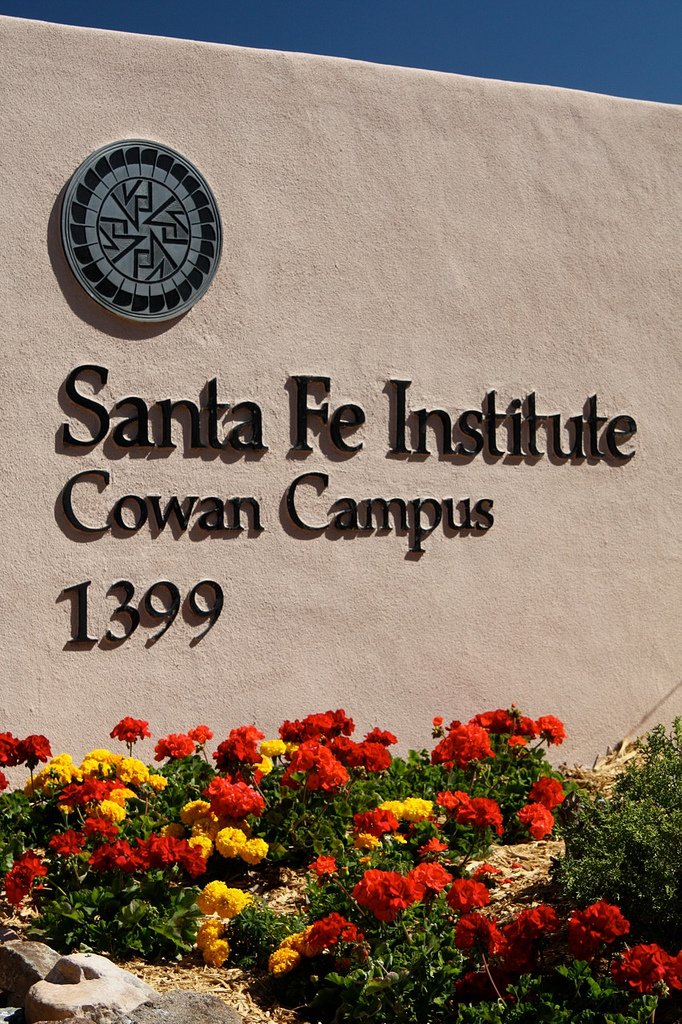
Nonprofit centre in Santa Fe, New Mexico, founded in 1984 to study complex systems; its free Complexity Explorer courses teach agent-based modelling and scaling.
makes
-
Epstein and Axtell's 1996 Sugarscape experiments, which showed how migration, inequality, trade and conflict can grow from simple agents on a landscape; the founding book of agent-based social simulation.
Tags: agent-based, social simulation, sugarscape