person · draft
Thomas Schelling
American economist and 2005 Nobel laureate whose 1969 and 1971 papers showed how mild preferences about neighbours can tip a mixed area into segregation.
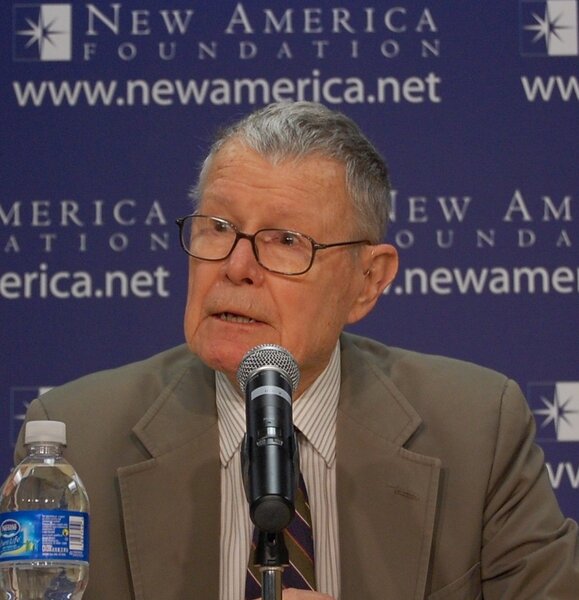
New America, Wikimedia Commons, CC BY 2.0.
Thomas Crombie Schelling (14 April 1921 to 13 December 2016) was an American economist who shared the 2005 Nobel memorial prize in economic sciences with Robert Aumann "for having enhanced our understanding of conflict and cooperation through game-theory analysis".1,2 From 1948 to 1953 he worked for the Marshall Plan in Europe and then in the White House.1 He went on to teach at Yale and Harvard, joined Harvard's Kennedy School in 1969, and moved to the University of Maryland in 1990.1,2 His 1960 book The Strategy of Conflict introduced the ideas of the focal point and the credible commitment.2
His best-known work among modellers is on segregation. In papers from 1969 and 1971 on what he called a general theory of tipping, he showed that a preference for neighbours of the same colour, or even a preference for a mixture up to some limit, can lead to complete segregation. He demonstrated it with pennies and dimes on graph paper, moving each coin that was unhappy with its neighbours one at a time.2 His 1978 book Micromotives and Macrobehavior generalised the argument and is often cited in agent-based computational economics.2 He took part in debate on global warming from 1980, when he chaired a commission on it for President Carter.2 He argued that cutting emissions is a bargaining problem: rich countries would bear most of the costs and poor countries would get most of the benefits.2
His segregation model is the basis of the playable post Parable of the Polygons, and the picture on the AgentPy entry shows it running in a Jupyter notebook.
- affiliation
- University of Maryland
- role
- economist
Tags: Schelling model, segregation, game theory, tipping points