person · draft
Warren Weaver
American mathematician and science administrator at the Rockefeller Foundation, whose 1948 essay Science and Complexity described the problems of organized complexity.
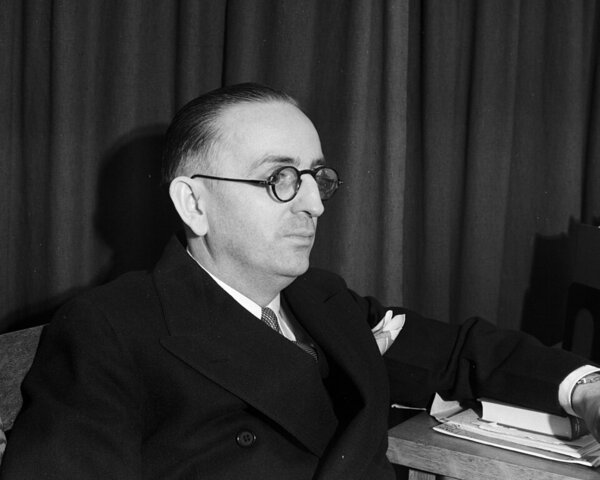
Donald Cooksey, Wikimedia Commons, public domain.
Warren Weaver (17 July 1894 to 24 November 1978) was an American mathematician and science administrator.1 Born in Reedsburg, Wisconsin, he studied at the University of Wisconsin, taught mathematics there and chaired its department from 1928 to 1932, and with his mentor Max Mason wrote the textbook The Electromagnetic Field (1929).2 In 1932 Mason, by then president of the Rockefeller Foundation, persuaded him to lead the foundation's programmes in the natural sciences, which he directed until 1955.1,2 He funded experimental biology and work across the biological and physical sciences, and gave the resulting field its name, molecular biology. Agriculture was added to his portfolio in 1950, and the foundation then backed research on more productive crop varieties.2
During the Second World War he organised the Applied Mathematics Panel, whose interdisciplinary teams developed techniques in sequential analysis and operations research.2 He wrote the short article for general readers that was published with Claude Shannon's papers in The Mathematical Theory of Communication (1949), and in July 1949 a memorandum, "Translation", that set out early goals and methods for translating between languages by computer.1 He was later vice president of the Alfred P. Sloan Foundation, from 1959 to 1964, and in 1963 published Lady Luck, a book on probability for readers without mathematics.2
He is the author of Science and complexity, his 1948 essay that sorts the problems of science into simplicity, disorganized complexity and organized complexity, and expects electronic computers and mixed teams of scientists to make headway on the last.
- affiliation
- Rockefeller Foundation
- role
- mathematician and science administrator
makes
-
Warren Weaver's 1948 essay sorting science's problems into simplicity, disorganized complexity and organized complexity, and betting on computers and mixed teams for the last.
Tags: complexity, history, operations research