term · draft
Foresight and anticipation
The study of possible futures in order to act now, also called futures studies or strategic foresight: where it is taught, its roots in anticipatory democracy, and why it avoids the word predict.
Foresight is an approach to thinking about the future and exploring possible futures, meant to inform collective action and decisions by taking the long term into account.25 It is also called futurology and futures studies, and in French prospective.25 The University of Houston defines it as "the study of change that uses a systematic methodology to explore the future in order to make better decisions today".1
Where it is taught
The Finland Futures Research Centre calls itself "one of the few university departments devoted to futures research in the world".6
- University of Houston. A Master of Science in Foresight: 30 graduate hours including a project or thesis, taught online.1 The programme was founded in 1974 at the University of Houston-Clear Lake and moved into the College of Technology in 2005; the university then called it the longest running master's programme in future studies in the world.2
- University of Hawaiʻi at Mānoa. The Hawaii Research Center for Futures Studies was established by the Hawaii State Legislature in 1971 and sits in the Department of Political Science; its activities are overseen by Jim Dator.3 It offers an Alternative Futures MA option, which normally takes two to three years, futures-oriented PhD work in political science, and undergraduate courses.4 Its students "are taught to see futures as multiple and open".4
- OCAD University. A Master of Design in Strategic Foresight and Innovation, part-time online over three years or full-time in person over two.5
- University of Turku. The Finland Futures Research Centre was founded in 1992 by three universities in Turku and is a department of the Turku School of Economics.6 It runs an international Master's Degree Programme in Futures Studies of 120 ECTS credits, and doctoral study.7 It is the permanent advisor to the Committee for the Future of the Finnish Parliament.6
- UNESCO. UNESCO's Management of Social Transformations Programme has an initiative on futures literacy and foresight, and runs a lecture series with the UNESCO Chair in Interdisciplinary Anticipation and Global-Local Transformation at Eurac Research in Bolzano.9 At the University of Trento, Roberto Poli holds the UNESCO Chair in Anticipatory Systems and teaches Social Foresight.8
Anticipatory democracy
Alvin Toffler's Future Shock was published by Random House in 1970.10 As a response to the shock of rapid change, Toffler proposed a more "anticipatory democracy".14 In David Guston's reading, "anticipatory" meant long-term forecasting, especially computer models of economic and demographic trends, and "democracy" meant town halls that gave citizens some control over their lives.14
Toffler formed a committee of over fifty people in 1975 to spread anticipatory democracy groups, and most of the contributors to the book that followed were members.13 That book, Anticipatory Democracy: People in the Politics of the Future, was edited by Clement Bezold with an introduction by Toffler and published by Random House in 1978.12 It describes the idea as a process "for combining citizen participation with future consciousness", with sections on cities, states and regions, legislatures, the workplace and citizens' movements.13
Congress was building foresight into its own work in the same decade. In 1974 the House required its committees to undertake "futures research and forecasting" on matters in their jurisdiction, and the Congressional Research Service set up a Futures Research Group the next year.10 The Congressional Clearinghouse on the Future was founded in 1976 by members who wanted more foresight in lawmaking, and at its height counted more than 100 members from both parties.11 Its monthly "Dialogues on America's Future", founded by Representative Charles Rose, heard speakers including Toffler.10 The Clearinghouse was a Legislative Service Organization and was dissolved in January 1994 under new rules for such bodies.11
Newt Gingrich met the Tofflers in the early 1970s and, while he was teaching at West Georgia College, they invited him to their Conference on Anticipatory Democracy in Washington as the lone Republican.15 He later wrote the foreword to one of their books, and in his first week as Speaker in 1995 named Future Shock one of "four books [that] describe everything we're going through".15 The Tofflers called him "a third-wave leader" while disagreeing with some of his positions.16
Anticipatory systems
The biologist Robert Rosen defined an anticipatory system in Anticipatory Systems (1985) as one "containing a predictive model of itself and/or of its environment, which allows it to change state at an instant in accord with the model's predictions".17 Its publisher credits the book with founding the area of anticipatory systems theory.18 Read this way, a digital twin whose forecasts are used to change the place it models is an anticipatory system in Rosen's sense.
The vocabulary
The Institute for the Future (IFTF) in Palo Alto was founded in 1968 as a nonprofit spinoff from RAND, with its early foresight built on the Delphi method.19,20 Its fellows include Mike Liebhold.28 Marina Gorbis, its executive director, puts "Forget about predictions" first among her principles for futures thinking, and writes, "If somebody tells you they can predict the future, don't believe them."22 She separates point predictions of single events, such as elections, from the large transformations IFTF studies.22 The words practitioners use instead:
- Forecast. IFTF still uses the word, as in its Ten-Year Forecast.20 Futuribles distinguishes foresight from forecasting, which "is based on mathematical models".24
- Foresight. For Futuribles, "not about predicting the future but exploring the different possible futures".24
- Signals and drivers. Signals are "evidence of the future that we can find in today's world"; drivers are "broad long-term trends".21
- Alternative futures, or scenarios. Dator writes that "Futures studies is not about correctly predicting The Future" but studies "images of the future", sorted into four generic futures: continuation, collapse, discipline and transformation.23
- Futuribles. The name of the periodical created by Bertrand de Jouvenel, author of The Art of Conjecture.27 A RAND paper describes Project Futuribles as working on the premise that "the future is not a given unknown but one of many possible futures".26
- Futures literacy. UNESCO says being futures-literate "enhances our ability to prepare, recover and invent in the face of change".9
Prediction and simulation
Dator allows that accurate prediction is possible only for the most narrowly and near-term focused things, not for "the future" as a whole.23 Futuribles separates foresight from forecasting because foresight partly takes in qualitative data and the interactions between phenomena.24 A simulation engine runs stated rules forward from a starting state and returns values for a later date; TimeLike and the World3 model behind The Limits to Growth are examples. Within the narrow, near-term range Dator describes, such a run can be checked against what happens. Beyond it, a futurist would read the same run as one image of the future among several.
- aka
- futures studies, strategic foresight, anticipation studies, futurology, prospective, futures literacy
refers to this entry as a source
Alvin Toffler's 1970 bestseller on the stress of too much change in too short a time, which ends by proposing "anticipatory democracy": public forecasting joined to citizen assemblies.
-
A 1978 collection edited by Clement Bezold, introduced by Alvin Toffler, on 1970s experiments that put forecasts and alternative futures before citizens, legislatures and city and state governments.
-
Robert Rosen's 1985 theory of systems that carry a predictive model of themselves and their surroundings and act now on what the model says will happen later; second edition 2012.
-
Bertrand de Jouvenel's 1964 book (English 1967) arguing that the future cannot be known, only conjectured as a range of possible futures, "futuribles", to be discussed openly and continuously.
discussed in
-
A 1978 collection edited by Clement Bezold, introduced by Alvin Toffler, on 1970s experiments that put forecasts and alternative futures before citizens, legislatures and city and state governments.
-
Robert Rosen's 1985 theory of systems that carry a predictive model of themselves and their surroundings and act now on what the model says will happen later; second edition 2012.
Wendell Bell's two-volume account of futures studies as a field: its history, purposes, assumptions, theory of knowledge, methods and values, written partly as a basic text for courses.
-
Alvin Toffler's 1970 bestseller on the stress of too much change in too short a time, which ends by proposing "anticipatory democracy": public forecasting joined to citizen assemblies.
-
Reference work in 77 entries on anticipation, the use of the future in decisions, drawing on biology, the social sciences, the humanities, engineering and computer science; Springer, 2019.
-
Bertrand de Jouvenel's 1964 book (English 1967) arguing that the future cannot be known, only conjectured as a range of possible futures, "futuribles", to be discussed openly and continuously.
cited by
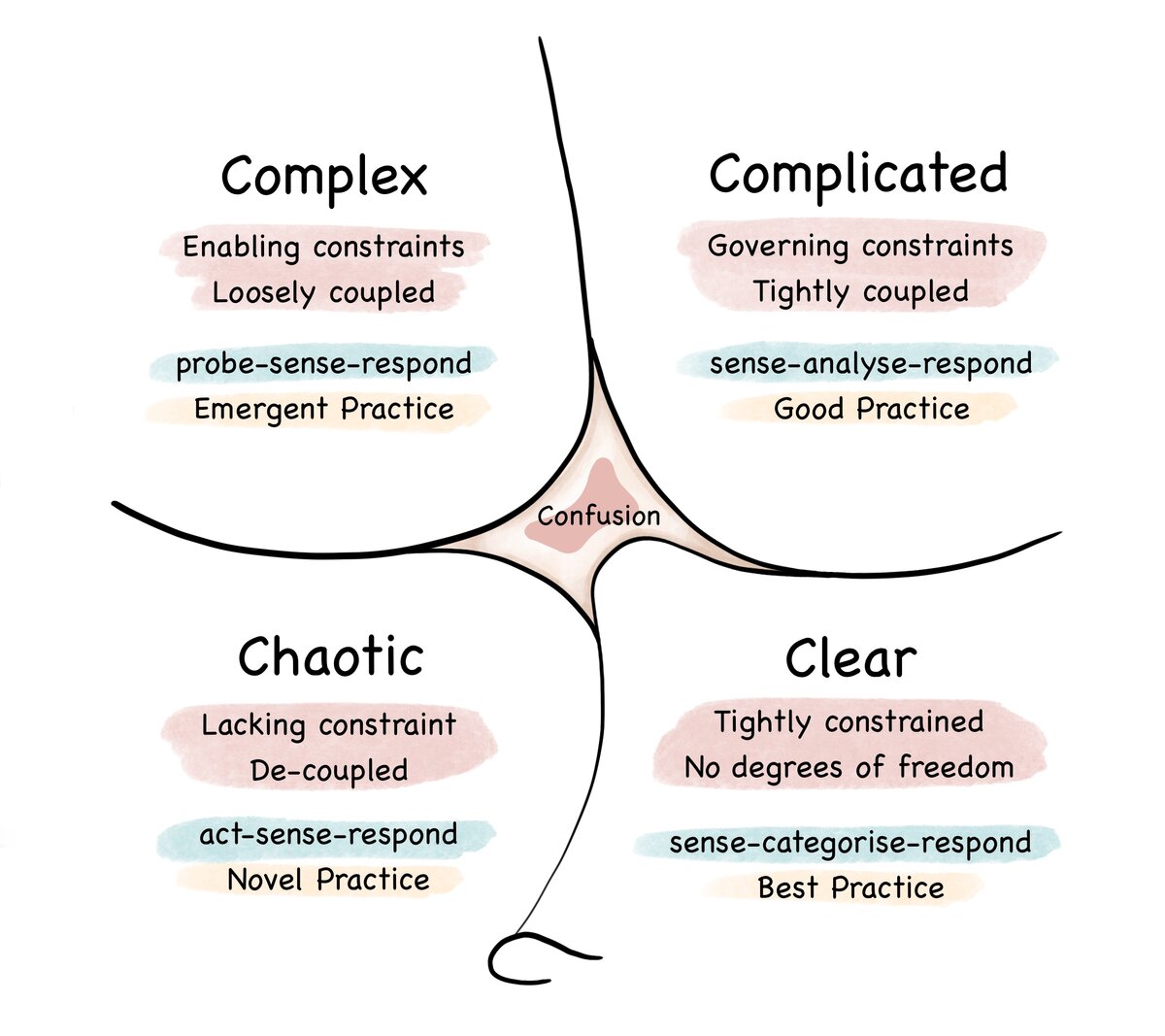
Dave Snowden's framework of five domains (clear, complicated, complex, chaotic and confused), each with its own mode of action and its own limits on prediction.
Tags: foresight, futures studies, anticipation, scenarios, forecasting, anticipatory democracy, futures literacy