article · draft
Globalization and the hinterland
Whether country people turn against trade depends on whether their own region's farming can compete: a study of 384,194 survey answers in 123 countries, European elections and the US after NAFTA.
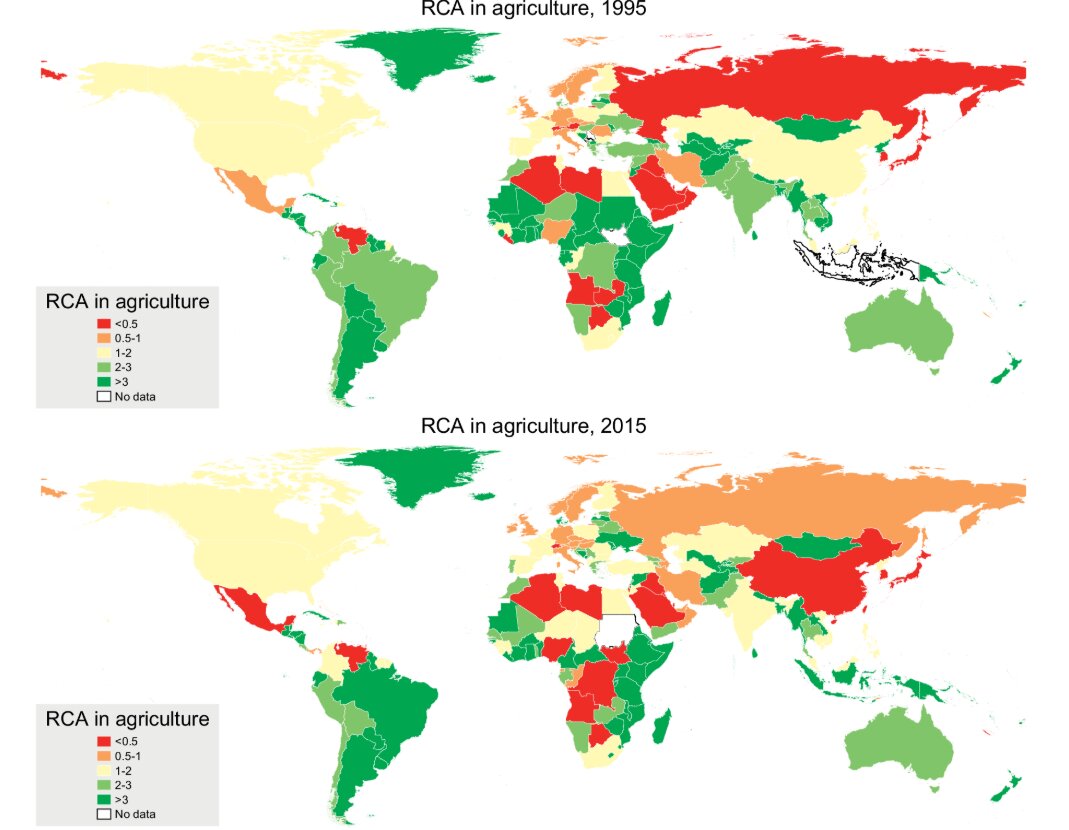
Figure 2 of the paper: revealed comparative advantage in agriculture by country, 1995 (top) and 2015 (bottom), from red (below 0.5) to dark green (above 3). Mansfield and Solodoch 2026, CC BY 4.0.
Country people are often said to oppose trade because they are left behind, or because their culture is more closed than a city's. Edward Mansfield (University of Pennsylvania) and Omer Solodoch (Hebrew University of Jerusalem) test a more material explanation. Farming is the one industry tied to the countryside, and in a farming area much of the rest of the local economy depends on it, from fertiliser and machinery dealers to banks and shops. So rural views on trade should follow whether the local farms can compete abroad.1 Where they can, trade is an opportunity. Where they can't, it is a threat to the whole community, including the many rural residents who don't farm.1
They test this three ways.1
Across the world. The authors pooled every cross-national survey they could find that asked about trade between 1995 and 2019, eight survey series in all, and call the result the Global Trade Attitudes dataset. It holds 384,194 people in 123 countries. Each country's competitiveness in farming is measured by UNCTAD's index of revealed comparative advantage: whether farm goods make up a bigger share of its exports than they do of the world's. In countries without that advantage, rural residents were about 5 percentage points less likely than city dwellers to support trade. The gap shrank and vanished as farming became competitive. The change came right at the threshold between advantage and disadvantage, so people seem to notice fairly small differences. The pattern held in poor, middle-income and rich countries alike, and it held whatever a person's own income, job or occupation.1
Within Europe. For 149 regions in 16 countries, mostly at the scale of NUTS-2 regions of 0.8 to 3 million people, the authors gave each region a share of its country's farm advantage according to how many of its people work in farming. Where local farming was uncompetitive, rural residents were 6.5 points less likely to back trade. Where it was competitive, the gap was 1.4 points and not significant.1 They then matched how people voted to party manifestos. In uncompetitive regions rural voters were about 8 points more likely to vote for a pro-farmer party, and over 7 points more likely to vote for economically nationalist ones. In competitive regions the pro-farmer gap fell to 1.4 points, not significant, and the nationalist gaps to under 3. Most of the difference ran through Christian Democratic parties, which have long protected and subsidised farming. Rural support for free-market Conservative parties was lower where farming was weak. The usual right-wing lead in the countryside was concentrated in regions whose farming couldn't compete, and almost disappeared in those where it could.1 Rural support for parties on other issues, such as technology, education or civil rights, did not change with farm competitiveness.1
The United States after NAFTA. Export statistics reflect tariffs and subsidies, which in turn reflect what voters want, so the authors needed something politics can't move. They used a measure built by Amodio and colleagues from the FAO's Global Agro-Ecological Zones model: the yields that soil, terrain and climate allow in each congressional district, for crops covered by trade agreements, compared with Canada and Mexico.1 The same model underlies the CADI map of crop yields under climate change. Using the American National Election Studies for 1996 to 2000, the authors found:1
- Trade: in districts below the median, rural residents were 15 points more likely than urban ones to want import limits. In competitive districts there was no gap, and urban and suburban opinion did not move with farm advantage at all.
- Votes: in uncompetitive districts, rural voters were 16 points less likely than urban ones to vote for Clinton in 1996 or Gore in 2000, both champions of NAFTA. Before NAFTA, in 1992, rural voters in these districts had voted much like urban ones. The change came from earlier Clinton voters staying home in 1996 rather than switching to the Republicans or to Perot.
- Who: the effect held for wage earners outside farming, and as strongly for people who had lived in the place for decades as for newcomers. So the pattern is not explained by protectionist people moving to the countryside, nor by landowners alone.
- Why: it showed up in how rural people judged the national economy and which party would handle it better, not in their own finances or fear of losing a job.
County data show what NAFTA did on the ground. In rural counties with competitive farming, farm owners' income rose, and so did pay and some jobs outside farming. Rural counties without that advantage saw no wave of layoffs or flight. They fell behind, with slower wage growth and flat employment. The authors contrast this with the factory towns hit by imports from China. In cities, farm competitiveness made no difference to wages or jobs.1
For someone modelling how a rural place will react to a trade deal or a change in what its land can grow, the useful finding is that the response can be predicted from something measurable: whether the local farms can compete. A person's own job and income predict it less well. Comparative advantage can also shift, and the paper names climate change as one cause. Whether climate shocks, new trade agreements or the rules of the green transition provoke the same reaction is a question they leave open.1
The survey compilation, the regional measures and the code are published on the journal's Dataverse.2 The paper is open access under CC BY 4.0, so its Figure 2 can be shown above. It maps each country's advantage in farm exports in 1995 and 2015: China moved from advantage to disadvantage, while Brazil, Ukraine and Zambia gained.1
- url
- https://doi.org/10.1017/S0003055426102111
- published
- 2026-10-29
- publisher
- American Political Science Review (Cambridge University Press)
- authors
- E. D. Mansfield, O. Solodoch
helps answer this question
-
Who lives here, what would a change do to their days, and how would they react to it, before anyone tries it on the real place?
refers to this entry as a source
-
Global 10 km map of observed and projected change in attainable crop yields under climate change, from a team at IAE-CSIC and the Barcelona School of Economics, measured in people fed per grid cell.
Tags: rural–urban divide, agriculture, trade, comparative advantage, voting, public opinion, paper