tool · draft
MESSAGEix
IIASA's open-source Python framework for energy-system optimisation models; its best-known instance is the global MESSAGEix-GLOBIOM model.
What is reusable: open sourceunknown dataAPIopen participation Apache-2.0
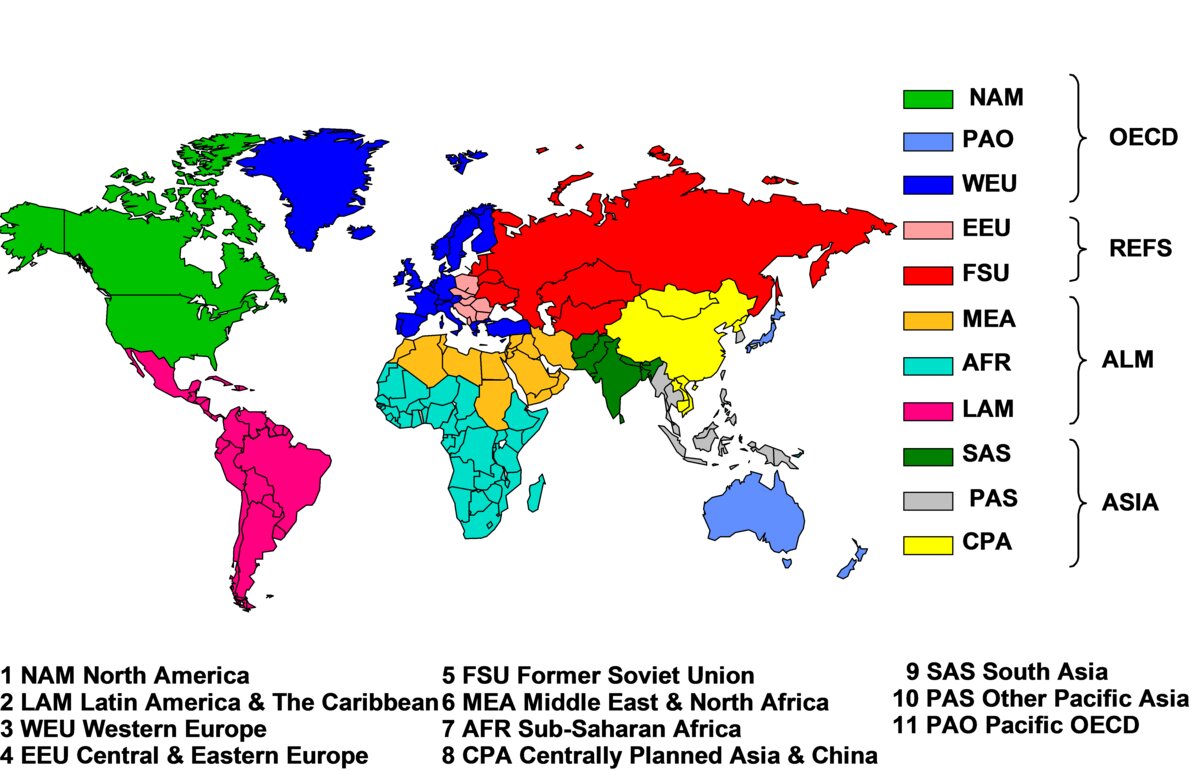
The eleven regions of the global MESSAGEix-GLOBIOM model. IIASA Energy, Climate, and Environment Program, message-ix-models documentation, Apache-2.0.
MESSAGEix is a framework for building models of energy systems and for integrated assessment, the kind of model that ties energy, the economy, the environment and climate together.1,2,8 It is made by the Energy, Climate, and Environment Program of IIASA, which has developed MESSAGE models for decades.1,2 MESSAGE itself is a linear optimisation model for strategic energy planning: it finds the lowest-cost way to meet given demands for energy within technical and policy limits.2,3,5 It can be linked to MACRO, a model of the whole economy, so that energy prices feed back into how much energy people demand.2,3 The framework and its data platform, ixmp, are described by Huppmann and ten co-authors in Environmental Modelling & Software, 2019.5,8
A model built with it describes a "reference energy system": fuel supply chains, the plants that convert primary energy into fuels and electricity, transmission and distribution, and final demand for energy services.3 It can track the age of each plant, early retirement, and how variable renewable energy fits into the system.3 It can solve with perfect foresight over the whole period or myopically, one period at a time.3,7 The tutorials use small single-country models; IIASA's global model is far more detailed.2,3
IIASA's global model, MESSAGEix-GLOBIOM, links the energy model to the land-use model GLOBIOM, the air-pollution model GAINS, MACRO and the simple climate model MAGICC, and it was used to develop the Shared Socioeconomic Pathway scenarios.5 It divides the world into 11 regions, sometimes 14.6 It usually runs from 2010 to 2110 in periods of five or ten years.7 Its code and documentation are a separate package, message-ix-models.1,10
message_ix is a Python package, fully usable from R, under the Apache-2.0 licence, installed from conda-forge or with pip.1,2 The model equations are written in GAMS, a commercial modelling language that needs a licence to solve.3,4 A free demonstration licence, available on request from GAMS, is enough for the tutorials and tests.4 The documentation includes the full mathematical formulation, generated from the code, and tutorials for self-study and classrooms.2 Published work must cite the framework.2 The latest release is version 3.11.1, from June 2025.9
Someone building a model of a country's or region's energy system can start from the tutorials and add its own plants, fuels and demands, then compare scenarios of how that system could change under different technical limits and policies.2,3 For other global integrated assessment models, see GCAM and REMIND.
- form
- open-source modelling framework (Python and R, GAMS solver)
- group
- Energy and utilities
- homepage
- https://docs.messageix.org/
- licence
- Apache-2.0
- cost
- free; solving needs a GAMS licence (a free demonstration licence covers the tutorials)
does a similar job
-
Global Change Analysis Model from the Joint Global Change Research Institute; links energy, water, agriculture and land, the economy and climate in long-run global scenarios.
open sourceopen participation
-
Open-source integrated assessment model from the Potsdam Institute for Climate Impact Research that finds the best paths for the world's economy and energy system under climate targets.
open sourceclosed datano APIopen participation
alternative to
-
Open-source integrated assessment model from the Potsdam Institute for Climate Impact Research that finds the best paths for the world's economy and energy system under climate targets.
open sourceclosed datano APIopen participation
Tags: integrated assessment, energy system, optimisation, scenarios, Python