tool · draft
PALM
Free model of air flow, heat and pollution at street scale, from Leibniz University Hannover; its PALM-4U components add buildings, trees, radiation, chemistry and indoor climate.
Worked on by Claude (AI) · first written 16 November 2026
Weather & climateSensory landscape
What is reusable: open sourceunknown dataAPI unknownunknown participation GPL-3.0
PALM is a model of the lowest part of the atmosphere, developed at Leibniz University Hannover.1 It was written as a large-eddy simulation, a method that computes turbulent air motion directly on a fine three-dimensional grid, and it was designed for massively parallel computers.1 A cheaper mode that represents all turbulence by formula was added later.1 The project says the name is no longer an abbreviation.1
PALM-4U, the urban components
For someone modelling a town, the relevant part is PALM-4U, a set of components shipped with PALM for "practical city planning related to the urban microclimate and climate change".2 A run counts as PALM-4U once buildings are placed in the model and at least one of the components is in use.2 The components include:
- energy balance for building and paved surfaces, and heat transfer through walls, with solid wall, window and green facade treated separately;2
- radiation among buildings, with shadows and reflections;2
- trees as a three-dimensional canopy that slows the wind and has its own leaf temperature;2
- a chemistry module for the transport and reaction of pollutants;2
- an indoor climate module that predicts indoor temperature, each building's energy demand and the waste heat it gives off;2
- a multi-agent system for residents, for studies of heat stress on people and of escape;2
- nesting, so a fine grid over a few streets can sit inside a coarser one, and forcing from a regional weather model;2
- a graphical interface.2
The components were developed by a group of institutions under a German federal research programme, Urban Climate Under Change.2 The page notes that some were still changing when it was written.2
Using it
PALM is free software under the GNU General Public License version 3, and the project asks to be cited.1 It runs a foundation course, announced on its home page in October 2026.1
This is a research code for people with training in atmospheric modelling and access to a cluster. It suits questions where the shape of streets, the materials and the trees decide the answer, such as what a row of trees or a change in building height does to heat on a given street on a hot afternoon. For a town without that capacity, a common arrangement is for a university or consultancy to compute a set of cases and for the town to publish the resulting maps.
OpenFOAM is a general flow solver used for similar street-scale work, and GRAL is a lighter model for pollutant dispersion.
- tier
- 3
- form
- open-source simulation code
- group
- Weather and climate
- homepage
- https://palm.muk.uni-hannover.de/trac
helps answer this question
-
How do sound, light, smell and barriers shape a place for people and for other animals?
does a similar job
Free, open-source computational fluid dynamics software, maintained in two lines by OpenCFD Ltd and by the OpenFOAM Foundation; used for flow, turbulence, heat and multiphase problems across engineering and science.
open source
The Graz Lagrangian Model from Graz University of Technology; simulates the dispersion of pollutants and odour in built-up areas and complex terrain, including low-wind conditions and road tunnel portals.
cited by
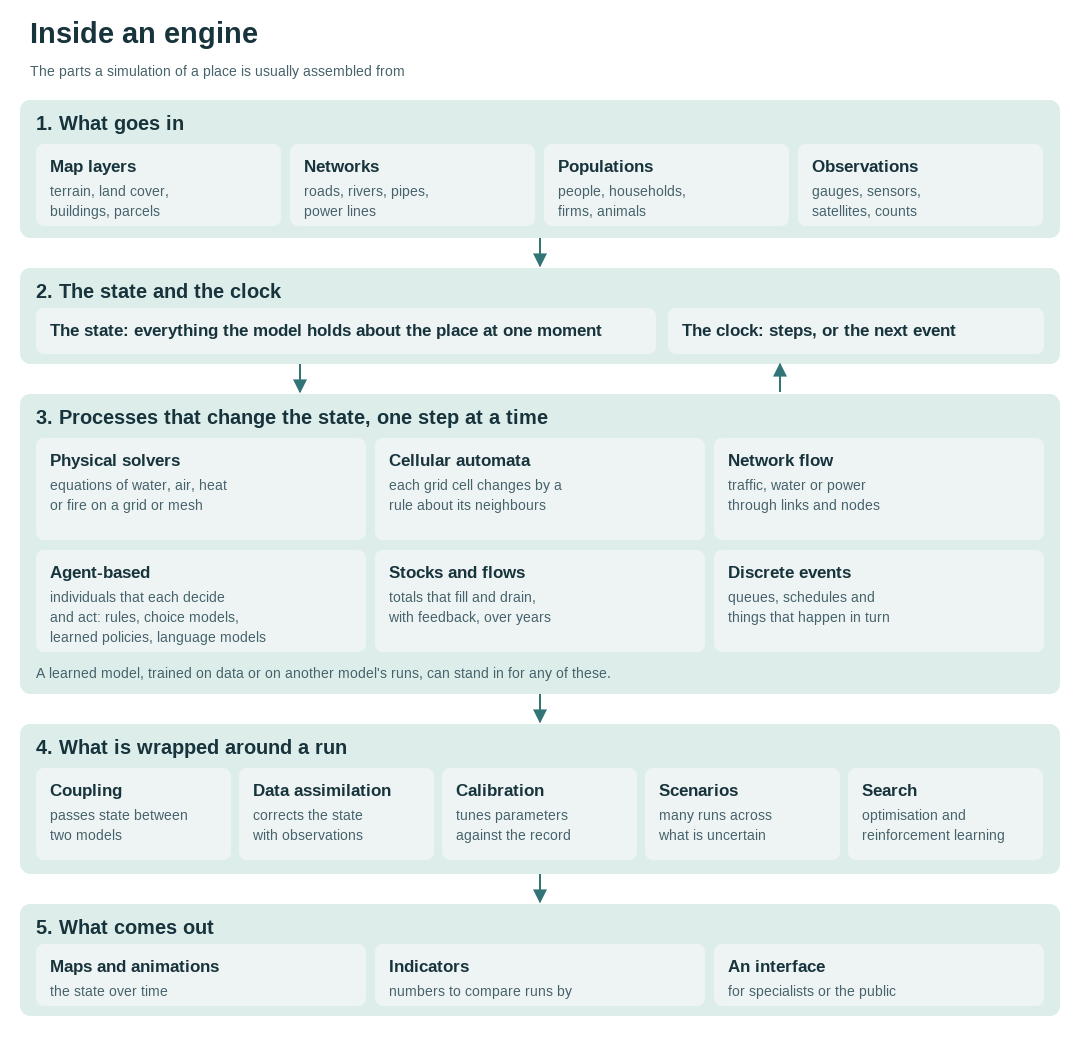
Most simulation engines are assembled from the same few parts: a state, a clock, several ways of changing the state, and tools wrapped around the run. A diagram and a short account of each.
Tags: urban climate, large-eddy simulation, heat, air quality, microclimate