organization · draft
LTER-LIFE
Dutch research infrastructure, founded in 2023, that gathers ecological data, models and tools for the Wadden Sea and the Veluwe into virtual labs for building digital twins of ecosystems.
LTER-LIFE is a Dutch scientific infrastructure for shared, integrated ecological research, working towards digital twins of ecosystems.1 It was founded in August 2023 with a ten-year grant from NWO, the Dutch Research Council.1,7 The grant (184.036.014) comes from NWO's Large-Scale Research Infrastructures programme.7 It starts with two of the most extensive and best-studied ecosystems in the Netherlands, one aquatic and one on land: the Wadden Sea and the Veluwe.1
The work is done by researchers and software developers at NIOO-KNAW, NIOZ, the University of Amsterdam, Wageningen University and RIVM, supported by teams at LifeWatch VLIC, Wageningen Research, the Netherlands eScience Center and DANS-KNAW.2 Marcel Visser of NIOO-KNAW chairs the steering board, and Geerten Hengeveld of NIOO-KNAW is executive manager; each site has a community coordinator.2 It builds on three national infrastructures. LTER-NL runs long-term ecosystem monitoring at two sites and is part of LTER-Europe. NemNet runs national monitoring of soil, water and air. LifeWatch develops virtual laboratories.2
It works in three ways: bringing together the researchers who study different parts of the same ecosystem, a portal to find data, models and tools for those communities (including old datasets), and a virtual research environment where they can be reused and connected.1 Inside that environment, a virtual lab gathers the data, models and analysis tools for one ecosystem, and a twin is assembled in the lab, updated with measurements from the real place, and used for experiments and scenarios on the computer.3 The models can be process-based, written from how the system works, or data-driven, from statistics or machine learning; both are to be made findable, accessible, interoperable and reusable (FAIR).3 LTER-LIFE is to be an open-source infrastructure: users can run its assets on their own machines or in the cloud through its partner SURF, and workflows and data used in projects get a persistent identifier and are stored by DANS-KNAW and SURF.3 The lab environment it uses is NaaVRE, which it is developing further for building twins.4
LTER-LIFE is building its services step by step, and several can already be tried, some at an early stage.4
- NatureDataCube, geodata for Dutch nature areas through one API (below).4
- NaaVRE, the virtual lab environment.4
- The LTER Data Registry, to register and find ecological data collected on the Veluwe and IJsselmeer LTSER platforms (long-term research sites).4
- The Waddenregister, Datahuis Wadden's search engine for Wadden Sea data and metadata.4
- A prototype twin that calculates the primary productivity of the Wadden Sea, the growth of its algae, at chosen moments, built to learn what a full twin would need.4
- A metadata template for data used in ecosystem twins, a checklist (FAIR+SET) that suggests how to share a dataset better, and a hands-on guide to FAIR ecological data.4
Its code is on GitHub. It includes a NaaVRE virtual lab for a forest landscape model of the Veluwe, setups of 3D GETM-BFM models of the Dutch Wadden Sea, a browser viewer that compares coastal-sea model output with observations, and a metadata harvester that uses large language models.6
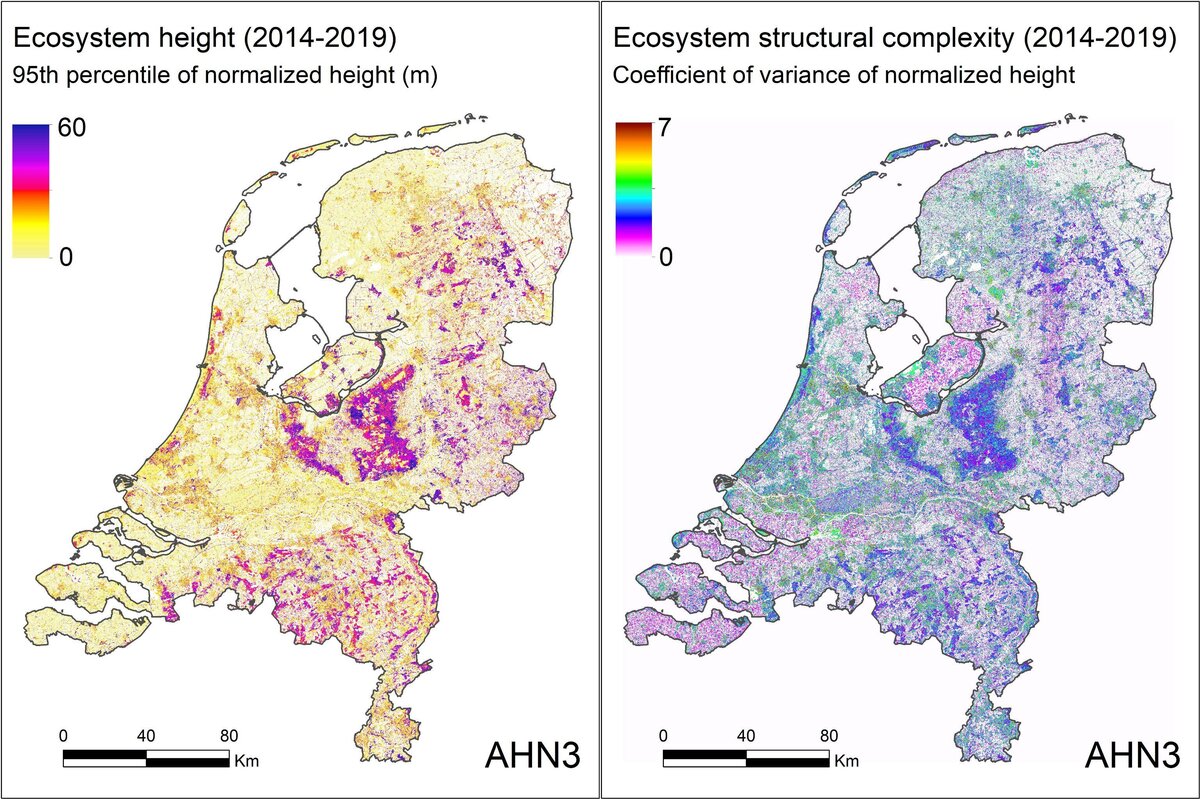
NatureDataCube, made by Wageningen Environmental Research as an initiative of LTER-LIFE, serves geodata for Dutch nature areas through a STAC API (STAC is an open standard for catalogues of maps and satellite images, readable by QGIS, ArcGIS Pro and Python tools).5
Its collections are:5
- vegetation index (NDVI) and colour images from Sentinel-2
- terrain and object heights from AHN, the national elevation survey
- the boundaries of 34 Dutch long-term research sites and about 264,000 nature management parcels
- ammonia, nitrogen oxide and total nitrogen deposition from RIVM, which are modelled, not measured
- land use from LGN and the Dutch soil map, both at 5 m
Weather and groundwater are in development.5 A free token is needed, and the data are under CC BY-NC-SA, free for non-commercial use.5 An R package and a Shiny interface for it are on GitHub.6
The group's view of what a twin of an ecosystem is, and how to build one, is set out in Digital twins as a tool for ecosystem research, whose authors all belong to LTER-LIFE.7 For someone modelling a place in the Netherlands, NatureDataCube is a ready source of site-level data. Outside the Netherlands, the FAIR checklist and the hands-on guide to FAIR ecological data apply to any ecological dataset.4
- form
- research infrastructure
- homepage
- https://lter-life.nl/en
- country
- Netherlands
uses this engine, platform or technique
Open-source platform from LifeWatch ERIC and the University of Amsterdam that makes Jupyter notebook code into shared cloud workflows, organised in virtual labs.
open sourceopen participation
Tags: ecology, long-term monitoring, virtual lab, FAIR data, Wadden Sea, Veluwe, Netherlands