article · draft
Digital twins as a tool for ecosystem research
Fourteen Dutch ecologists and computer scientists set out five traits of a digital twin of an ecosystem, say why it is more than a model, and list fifteen studies partway there.
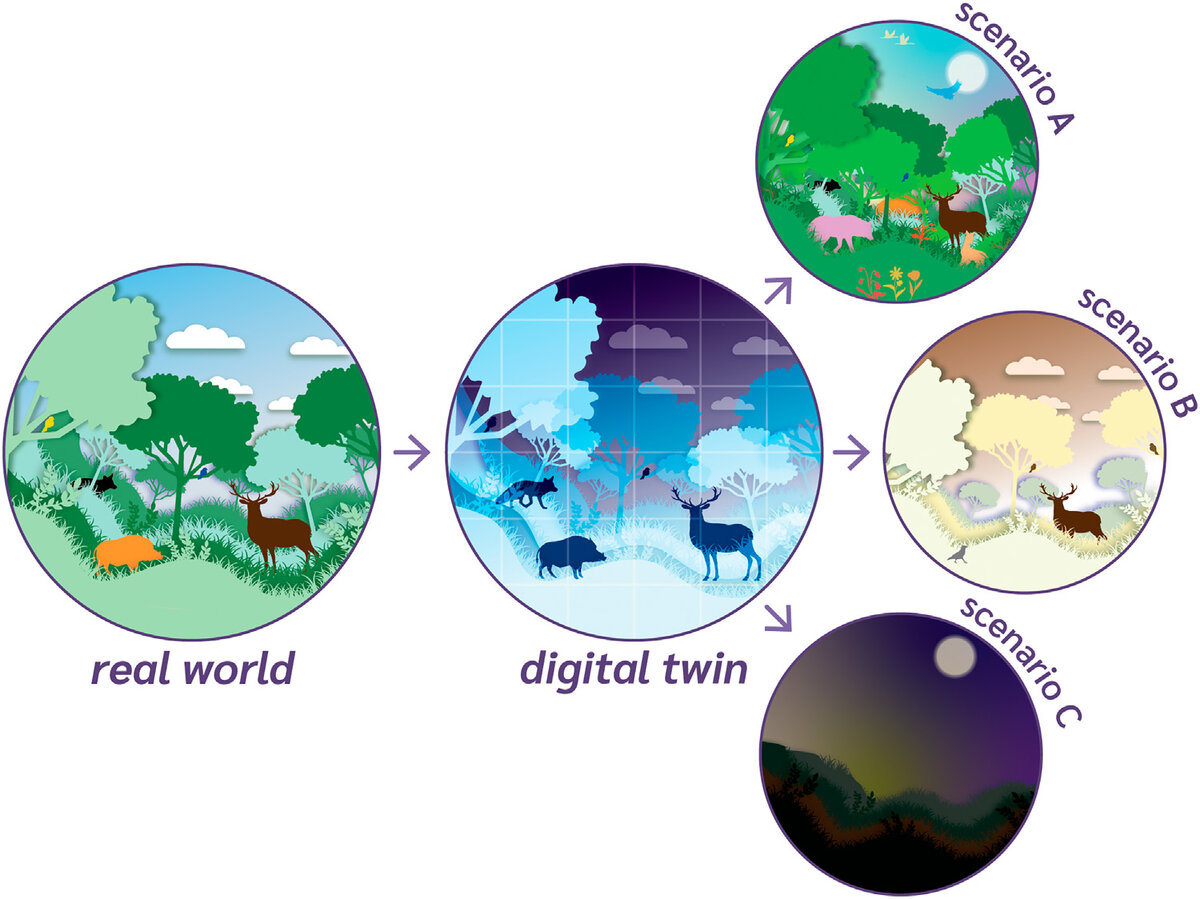
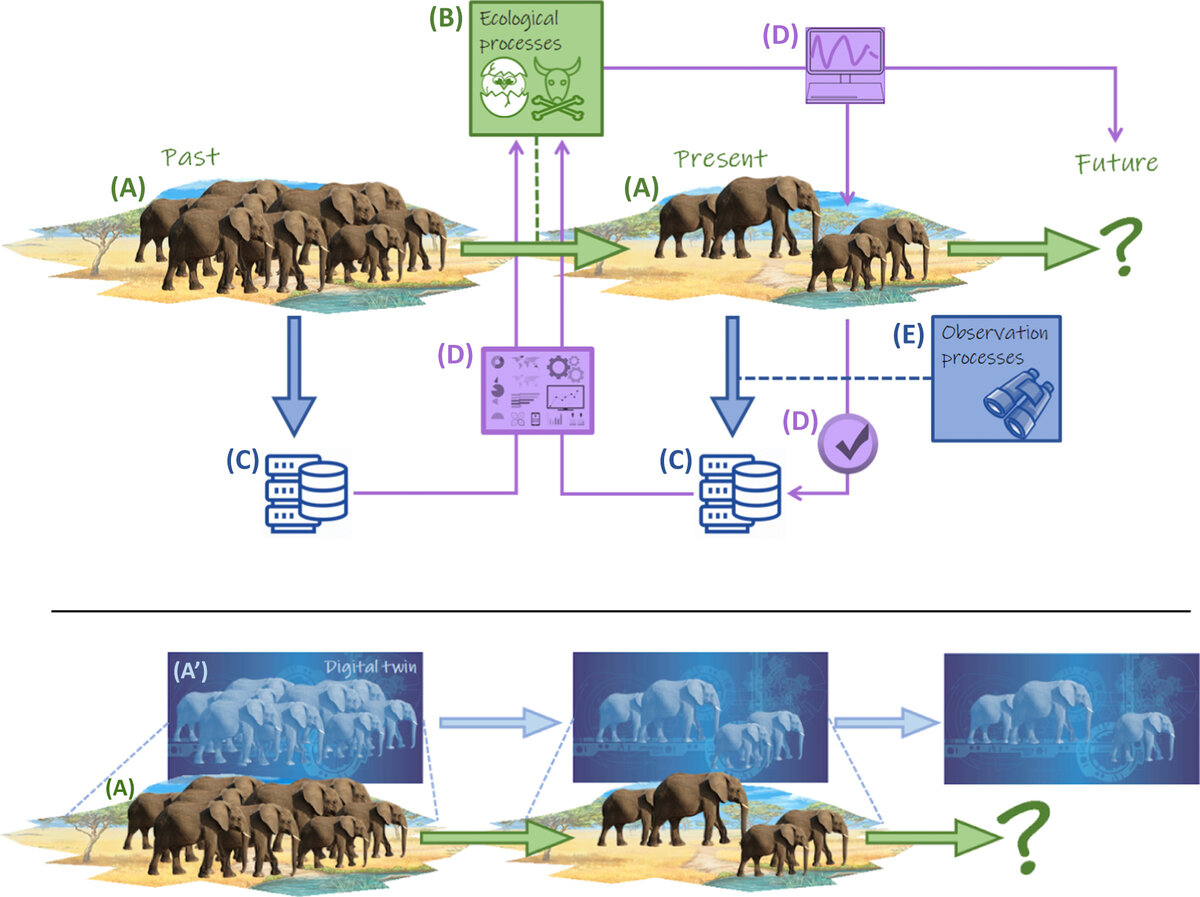
Figure 1 of the paper: one ecosystem, its digital twin, and three scenarios played out on the twin. Visser et al. 2026, CC BY 4.0.
The paper opens on a problem ecology has with itself. To say how a particular lake or heath will respond to a heat wave, a new dyke or a restoration plan, ecology has to become a predictive science. It is held back by three things: it can't yet combine the effects of several stressors at once, it struggles to link biodiversity to nutrient cycles and other ecosystem traits, and it rarely runs scenarios from local data across a whole ecosystem.1 The authors, fourteen ecologists, modellers and computer scientists from Dutch institutes who all work in the LTER-LIFE research infrastructure, propose digital twins as the way through.1,3
They name five traits, and say a twin could have them but need not always have all of them:1
- It is ecosystem-specific: anchored to an actual shallow lake, not a generic one.
- It has digital data streams from the ecosystem to the twin, and an information stream back.
- It integrates many sources: field observations and experiments, citizen science, cameras, acoustic recorders, sonar and radar, aircraft and satellite imagery.
- It combines models: process-based models alongside statistical and data-driven ones.
- It produces forecasts and scenarios, from short-term forecasts to long-term projections, or nowcasts that fill gaps in what was measured.
The picture above is their Figure 1. One real ecosystem has one twin, and on the twin three scenarios, such as three planned interventions, are played forward.1
Several of their choices are worth knowing before building one.
Specific, but not built from scratch each time. "Ecosystem-specific" doesn't mean a new twin for every wetland. The authors borrow the industrial idea of a prototype twin, a blueprint tailored to each instance, and cite a conference paper that modelled many unique wetlands in parallel this way. Nor does a twin have to cover a whole landscape. It can be the entire Wadden Sea, or the soil microbes of the Veluwe.1
How often to update is a design choice. Most of the literature stresses continuous updating. The authors argue that the update rate should follow the twin's purpose. A twin advising on interventions in a slowly changing system can be refreshed now and then, while one used for real-time decision support needs data as they come in. Whatever the rate, something has to flow back to the real place, predictions or suggested actions, because that return flow is what separates a twin from a digital shadow.1
Mechanism and data, together. The twin should hold process-based models, built from how the system works, and data-driven models, learned from what was measured, and keep reconciling the two as new data arrive, not just fit parameters once. The authors treat the two as ends of a spectrum and look for the point where each strengthens the other. Interpretable machine learning and knowledge-guided deep learning are their examples.1
Why it isn't "just a model". A twin is a model, they agree, but a special kind in three ways. It is about one ecosystem and does not try to generalise. It joins different kinds of data and models instead of using a single technique. And it is kept alive, updated and reused for new questions, where a published model is usually archived. Keeping it alive needs a community of researchers around the ecosystem, including the people who know the place best, whom another paper calls expert witnesses, to judge whether the twin behaves like the real thing.1
Scientists first. Some of the literature asks for interfaces that non-specialists can use. These authors want the first users to be the scientists who study the ecosystem, since they hold the knowledge to build a twin and are best placed to check it. Only after that would twins be extended to policymakers and the public. For the scientists they propose virtual labs, such as LTER-LIFE's NaaVRE: online workbenches with a catalogue of a place's data and calibrated models, where reusable assets can be assembled into a twin.1
Three examples of twins from the life sciences appear in a box.1
- A tomato crop in a greenhouse: a 3D simulation fed in real time from the greenhouse's sensors, meant as a decision aid for growers.
- The crane radar: a continuously updated forecast that tells birdwatchers where they are likely to see common cranes. It runs on historical migration data, wind forecasts and birdwatchers' own sightings.
- A prototype bee-hive twin: it simulates foraging, colony growth and Varroa mites from land-cover maps and daily weather. It comes from the European BioDT project, which the paper names as the one initiative so far to start building ecological digital twins.
Most of the work closest to twins does not use the word. The authors searched Scopus and list fifteen studies that have some of the five traits without calling themselves twins:1
- a restored tidal marsh at the Hedwige-Prosper Polder, tested against rates of sea-level rise;
- macroalgal blooms in the Yellow Sea;
- forest cover on Mount Kenya;
- mangroves at Le Morne in Mauritius;
- 164 glacier-fed streams;
- three shallow lakes in France;
- woody encroachment in Kruger National Park;
- methane from a peatland in northern Minnesota;
- two studies built on InVEST, one in Rasht County in Iran and one across four eastern German states.
Some run process models and others statistical or machine-learning ones. None combines a process-based model with a big-data model. Most don't say how often their data are refreshed.1
For building one, the authors take G. S. Blair's "jam sandwich" from a 2021 paper. The bread is integration and reuse of data and models in one place, interoperability and scalability. The jam is data science and AI, joining process and data models, and handling feedback and complexity.1 They dwell on the parts least familiar to ecologists. One is the virtual lab. Another is FAIR data, findable, accessible, interoperable and reusable: ecological data still sit in mixed formats with thin metadata, sometimes with no way to download them. The third is large language models that pull biodiversity facts, traits and metadata out of text, which they call promising but still in their infancy.1
The open questions they end on are some of the most useful parts of the paper.1
- What exactly is the physical thing? Ecosystems are loosely defined, and a twin needs a boundary.
- How do you train a twin of a slow place? Some species breed once a year, so a twin of one depends on long runs of legacy data, much of it scattered and without metadata.
- How do you check a twin? One that predicts many properties at once rests on many models fitted to many sources. The authors ask whether that takes living labs, where human pressure is deliberately varied, or back-casting at sites with long records.
- How do policymakers use the scenarios? They will need interfaces they can work with directly.
Their closing message is that the label matters less than the five traits. Whether a project is called a digital twin or a model, ecosystem research should integrate data, models and people around one real place.1 That is close to how this wiki uses the term (see What is a digital twin?). The paper names Destination Earth as a twin of the whole planet, the far end of the same idea. The paper is open under CC BY 4.0, so its figure can be shown here.1
The paper's own sources are a good reading list, and several are on this wiki. On what a twin is: Blair, de Koning and colleagues, Metcalfe and colleagues' maturity levels and Hazeleger and colleagues on Earth twins. On forecasting: Dietze and colleagues. On the parts: the Madingley ecosystem model, Movebank animal tracks and EMODnet marine data.1
- url
- https://doi.org/10.1016/j.tree.2026.04.016
- published
- 2026-08
- publisher
- Trends in Ecology & Evolution (Cell Press)
- authors
- M. E. Visser, G. M. Hengeveld, J. de Kraker, I. N. Athanasiadis, E. S. Bakker, W. D. Kissling, S. Nmor, C. J. M. Philippart, K. Soetaert, S. J. G. Vriend, A. Woutersen, Z. Zhao, Q. Zhan, A. F. Hof
is about this entity
-
A computational representation of a real object, place or system, linked to information about its real-world counterpart.
refers to this entry as a source
-
European research project, coordinated by CSC in Finland, that built ten prototype biodiversity models on the LUMI supercomputer, covering forests, grasslands, honey bees, bird migration, wild boar disease, invasive plants, crop wild relatives and genetic diversity.
partly open participation
Open-source suite of ecosystem-service models from the Natural Capital Alliance at Stanford; maps and values what nature provides in terrestrial, freshwater, marine, coastal and urban settings.
open sourceopen dataopen participation
The European Commission's Destination Earth builds digital twins of the Earth system, implemented by ECMWF with ESA and EUMETSAT; two twins so far, one for climate change adaptation and one for weather-induced extremes.
partly open dataAPIpartly open participation
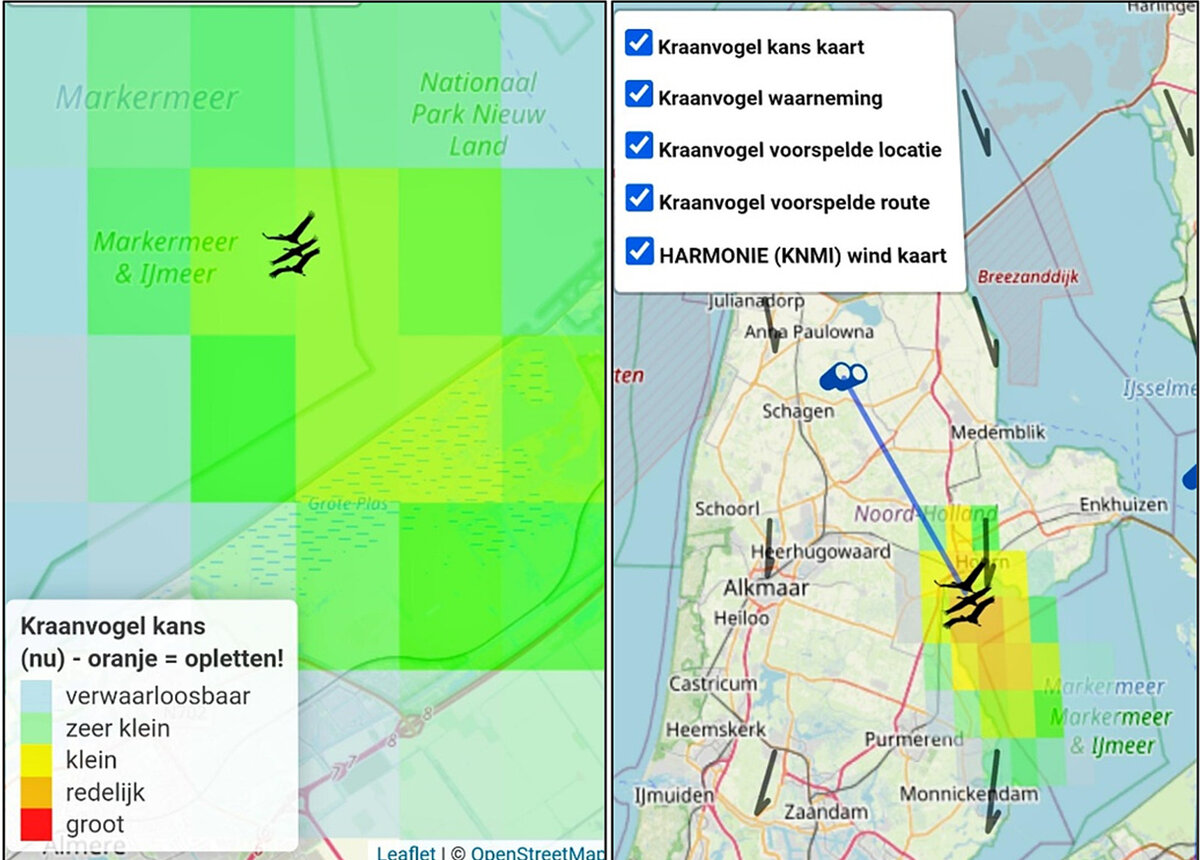
A live map of common crane migration over the Netherlands and its neighbours that joins birdwatchers' sightings to wind forecasts and flight models to show where flocks will likely pass.
open participation
Open-source platform from LifeWatch ERIC and the University of Amsterdam that makes Jupyter notebook code into shared cloud workflows, organised in virtual labs.
open sourceopen participation
-
Gordon Blair's short 2021 opinion piece asks whether a twin of the natural environment is just a model or just data assimilation, and sets out its building blocks as a "jam sandwich".
Eight ecologists and modellers set out what twins could do for ecology, five challenges peculiar to living systems, and four common misunderstandings, and urge people to start building prototypes.
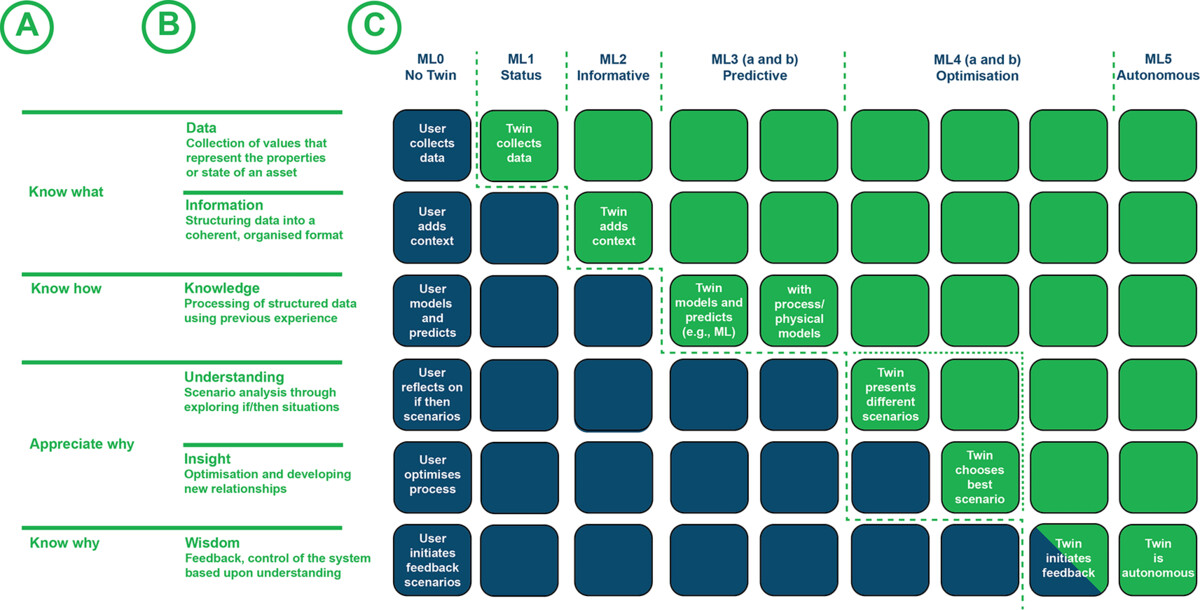
Four Wageningen researchers sort twins into five levels, from one that only reports status to one that acts on its own, so that a project can agree early on which kind it is building.
-
Nineteen ecologists argue that ecology should forecast days to decades ahead, check each forecast against new data and update it, and say what that requires.
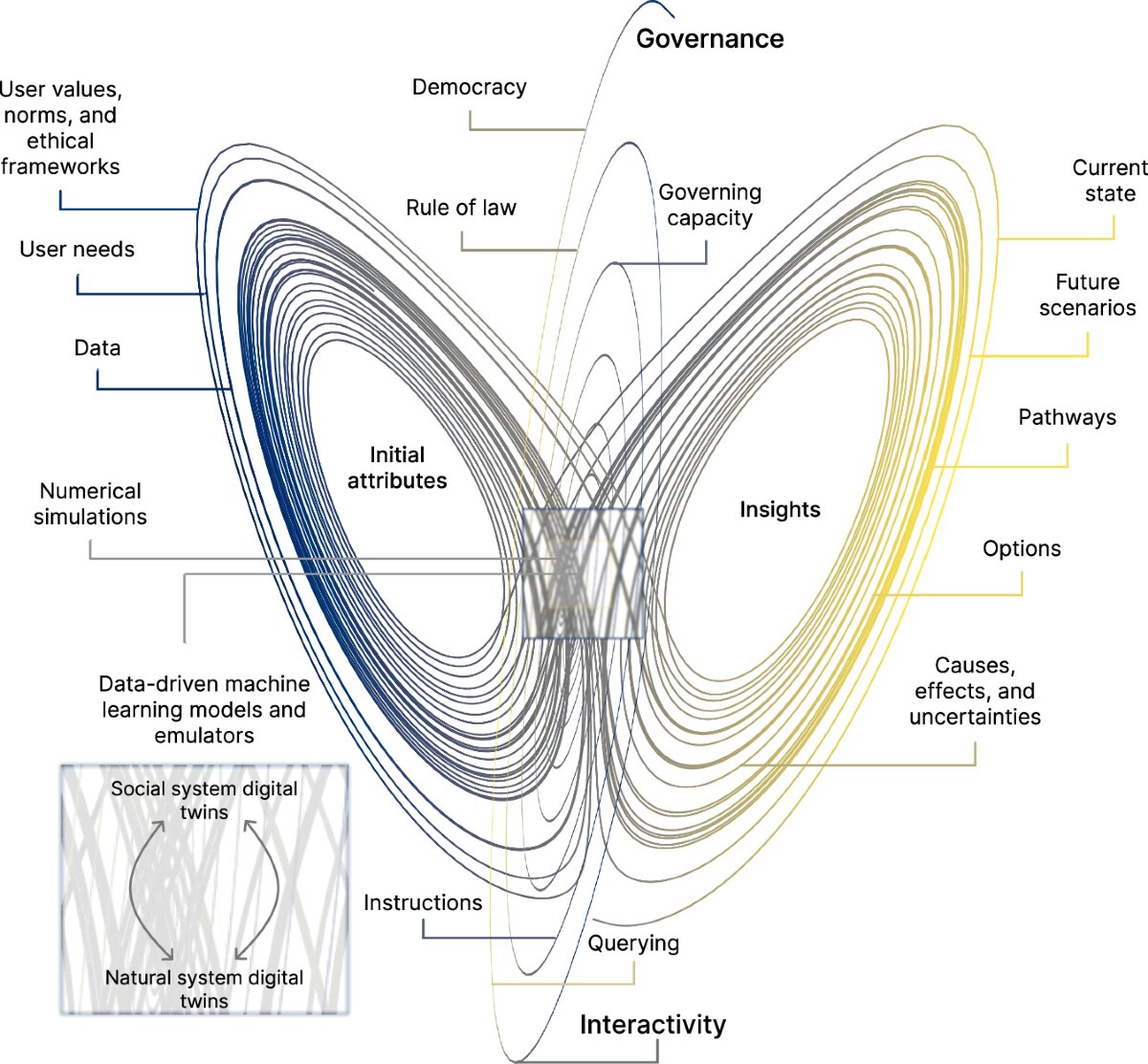
Twenty-eight scientists argue that digital twins of the Earth must model human behaviour and be governed openly by the people who use them.
-
Free database hosted by the Max Planck Institute of Animal Behavior where researchers keep, share and archive the tracks of tagged animals and readings from other sensors the animals carry.
partly open dataAPIopen participation
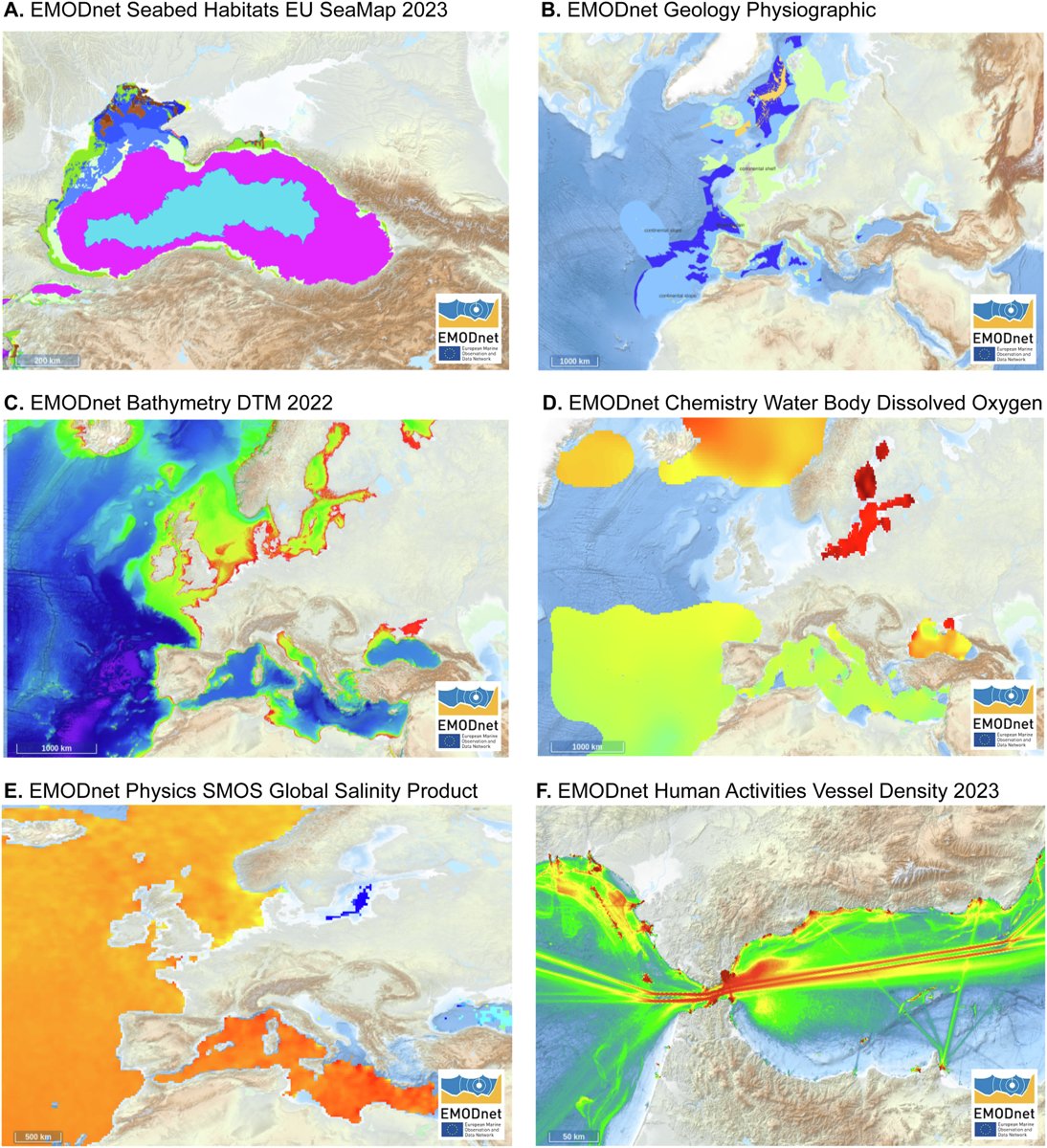
The European Union's free marine data service: measurements and maps of Europe's seas in seven themes, from seabed depth and habitats to species, chemistry and shipping, through one portal.
open dataAPIopen participation
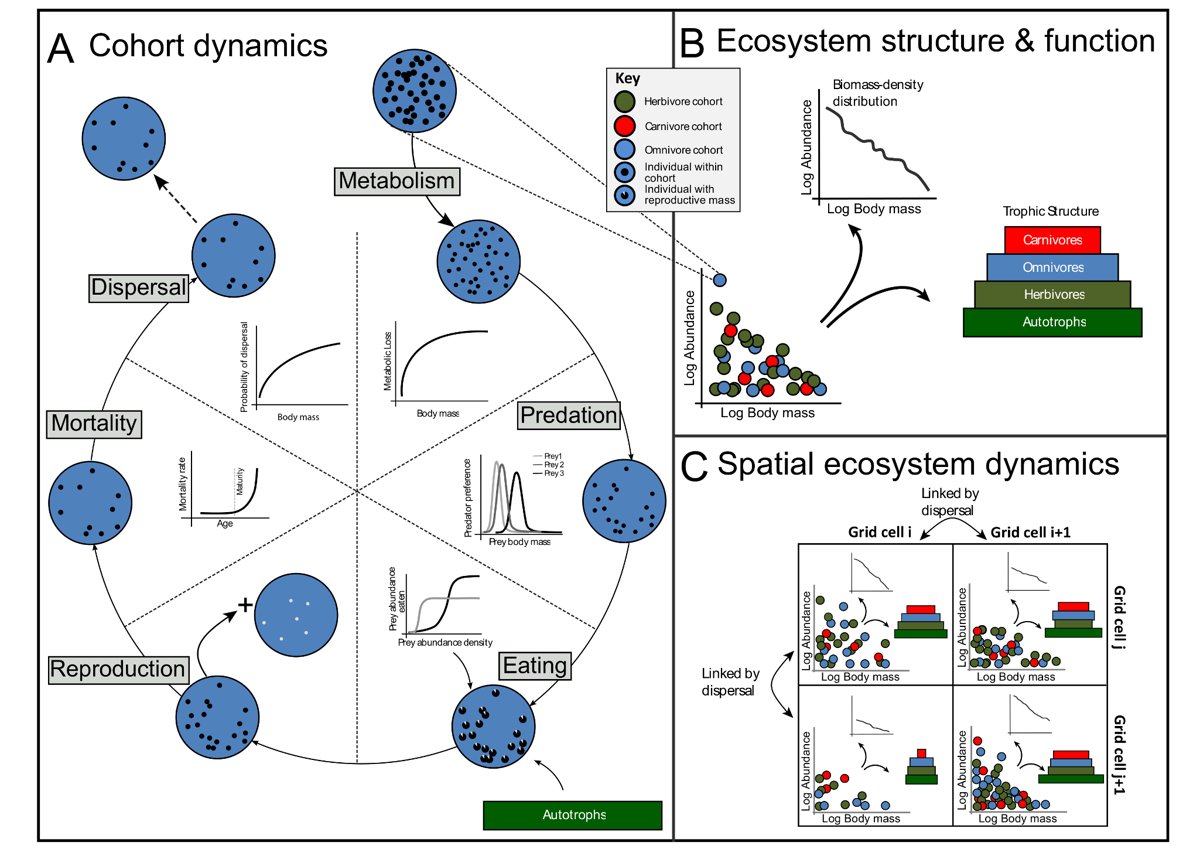
Open research model of plant and animal life on land and at sea, from plankton to whales, built from how organisms eat, grow, breed, move and die; runs from one grid cell to the globe.
open sourceopen dataopen participation
Tags: ecology, biodiversity, ecological forecasting, scenarios, virtual lab, FAIR data, definition, paper