organization · draft
Stockholm Resilience Centre
Swedish research centre, founded in 2007, that studies how people and nature interact; home of the planetary boundaries framework and the Regime Shifts DataBase.
Living systemsWeather & climate
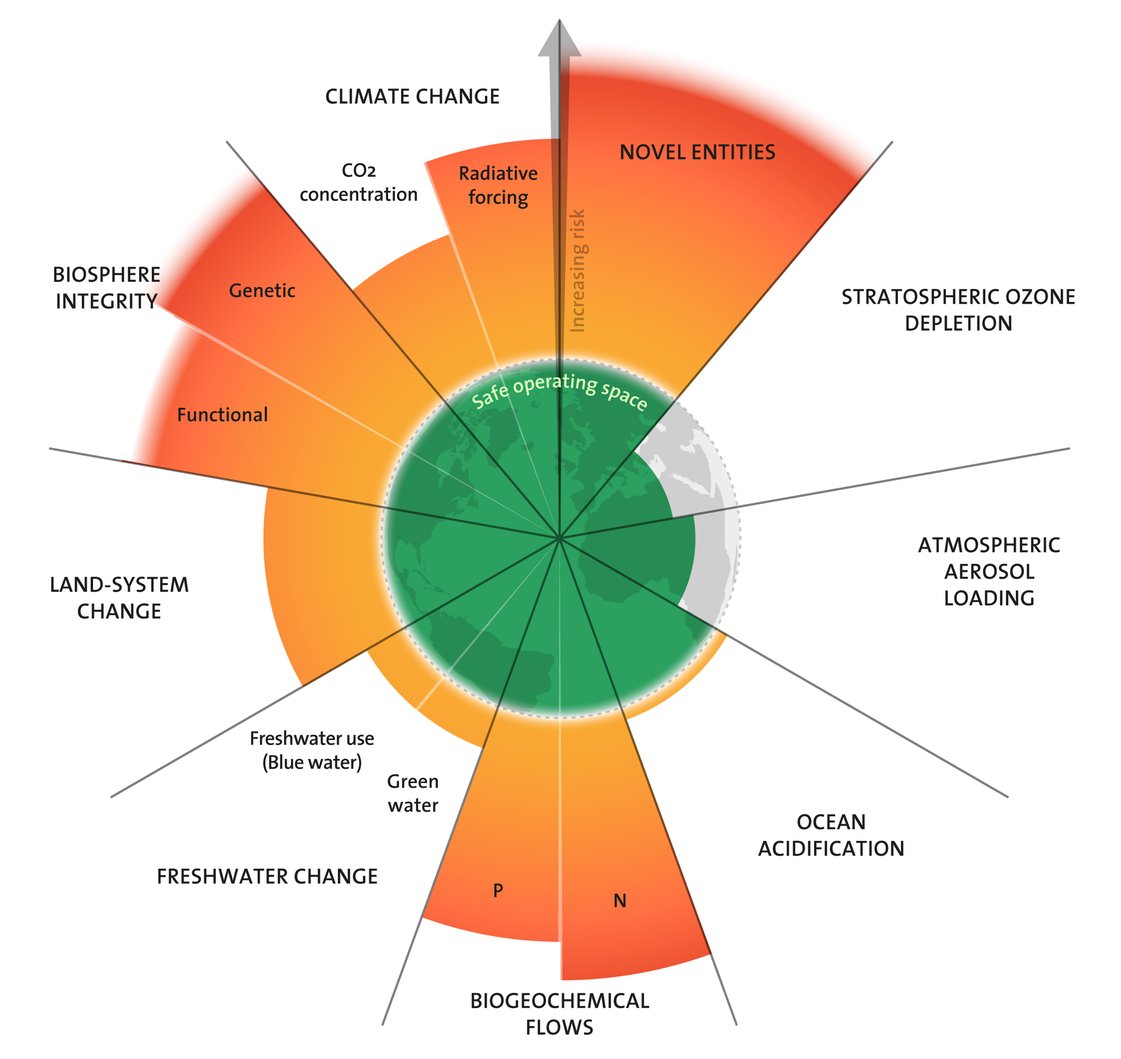
The planetary boundaries, 2026 update. Azote for Stockholm Resilience Centre, based on analysis in Sakschewski and Caesar et al. 2026. CC BY-NC-ND 3.0.
The Stockholm Resilience Centre was founded in 2007 as a collaboration between Stockholm University and the Beijer Institute of Ecological Economics at the Royal Swedish Academy of Sciences.1 Wikipedia names Johan Rockström and Carl Folke as its founders and the Swedish foundation Mistra as its first funder.4 It studies how people and nature can live and develop on a planet under pressure, treating the two as intertwined. Its research runs from local food systems to global financial markets, and it trains researchers and works with communities, companies and governments.1 It offers a master's programme, a PhD programme and independent courses.1
Its best-known work is the planetary boundaries framework. A planetary boundary is a quantified safe limit for human pressure on one of nine Earth processes: climate change, biosphere integrity, land-system change, freshwater change, biogeochemical flows of nitrogen and phosphorus, ocean acidification, atmospheric aerosol loading, stratospheric ozone depletion and novel entities.2 Crossing a boundary raises the risk of large, abrupt or irreversible environmental change, and the boundaries interact, so pressure on one process changes the risk on the others.2 A group of 28 scientists led by Rockström first proposed the boundaries in 2009. The first assessment of all nine came in 2023 and found six transgressed.2 Since 2024 the Potsdam Institute for Climate Impact Research has used the framework for a yearly Planetary Health Check, which has since found ocean acidification to be the seventh boundary crossed; the picture above is the 2026 update.2 The centre also offers an online course (a MOOC) on the Anthropocene, planetary boundaries and resilience.2
The centre's page reports that several regions, nations and cities have used the framework to assess their global environmental impact; its example is the 2020 report Planetary Boundaries New Zealand, which places that country's footprint against the safe limits.2 For someone modelling a place, that is the main use: a set of global limits against which a city's or region's share of pressure can be measured.
The centre also leads the Regime Shifts DataBase, a review of documented cases in which a social-ecological system has shifted abruptly from one state to another.3 Such shifts are what this site calls tipping points.
- form
- university research centre
- homepage
- https://www.stockholmresilience.org/
- country
- Sweden
Tags: resilience, planetary boundaries, social-ecological systems, sustainability, tipping points