data source · draft
World Data Centre for Greenhouse Gases (WDCGG)
The Japan Meteorological Agency's archive, run for WMO, of greenhouse gas measurements from stations, ships and aircraft worldwide, and the source of the global means in WMO's yearly Bulletin.
What is reusable: unknown sourceopen dataAPI unknownpartly open participation GAW Data Policy: free and unlimited for scientific use; acknowledge the providers and the data centre, and offer co-authorship for substantial use
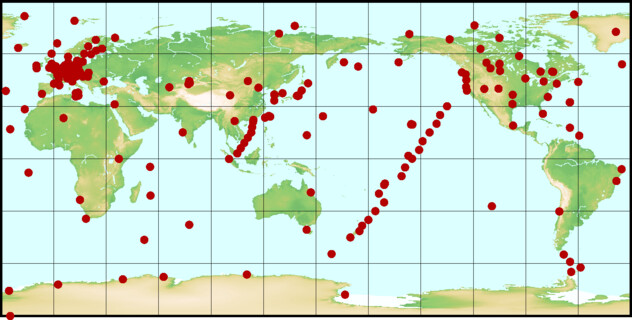
Stations used in the WDCGG global analysis for WMO Greenhouse Gas Bulletin No. 22. WMO WDCGG, October 2026; free to use with a citation.
The World Data Centre for Greenhouse Gases (WDCGG) collects, archives and distributes measurements of greenhouse gases made under the Global Atmosphere Watch (GAW) programme of the World Meteorological Organization (WMO).1 It holds carbon dioxide, methane, nitrous oxide and the CFCs, and related gases such as carbon monoxide.1 The Japan Meteorological Agency (JMA) runs it, and has since it was set up at WMO's request in October 1990.1 GAW coordinates observation of the chemical make-up of the atmosphere worldwide and is carried out by WMO Members with the scientific community; WDCGG is one of its seven world data centres.1 Reactive gases other than carbon monoxide moved to a separate World Data Centre for Reactive Gases on 1 January 2016.1
On 30 October 2026 its statistics page counted 215 stations and 33 mobile platforms with data, 59 gas species, 78 organisations that submit data, and data from 57 countries and territories.2 The largest contributor is NOAA's Global Monitoring Laboratory.8 About 41% of the records came from sites of NOAA's Cooperative Global Air Sampling Network, and 56 WMO Members contribute; the AGAGE network and ICOS, Europe's carbon observation system, also supplied data to the 2026 Bulletin.10 Some gas records come with meteorological data from the same site.4 It also holds satellite measurements of carbon dioxide from Japan's GOSAT and NASA's OCO-2.9
Each year WDCGG computes the global means of carbon dioxide, methane and nitrous oxide that WMO publishes in its Greenhouse Gas Bulletin.1,8 It uses only stations that measure on calibration scales traceable to WMO's, after screening, by the method in GAW Report No. 184.8 For the 2026 Bulletin that meant 180 stations for carbon dioxide, 172 for methane and 124 for nitrous oxide.10 Annual means from 1984 and monthly means come as CSV files with uncertainties at the 68% confidence level, and may be revised later after recalibration.8 NOAA also computes global means, from its own sites in the marine boundary layer, the air over the oceans taken to represent the background atmosphere.8 WDCGG adds inland stations it has judged representative. Its carbon dioxide mean therefore runs slightly higher than NOAA's, with similar trends and year-to-year swings.8 It also publishes an annual WMO WDCGG Data Summary of trends and seasonal cycles.1
Data are found through the site's search page.4 Files are UTF-8 text or NetCDF, each with a header built from the contributor's metadata, including the fair-use statement and the dataset's DOI.6,7 A file name gives the gas, the station, the platform, the sampling type (in situ or flask, for example), the contributor and the time step.7 Daily and monthly means, where WDCGG computes them at a contributor's request, are simple means of hourly and daily values flagged valid.6 Since January 2025 many files can be downloaded without an account; each contributor chooses whether its files are open or need a free registration, and registration is required for batch downloads of a gas and for the yearly fixed datasets.5 Registered users' names and email addresses are passed to the contributors whose data they download.3 The yearly fixed datasets, one per gas with its own DOI, hold the data used for that year's Bulletin and Data Summary and come as tgz archives.11,12 Records are updated whenever contributors submit, which for some is monthly and for others yearly.4
WDCGG says its archive is free and unrestricted.3 Under the GAW Data Policy it applies, access for scientific purposes is unlimited and free.3 Users accept that they will offer the data providers co-authorship whenever they make substantial use of their data, and any publication must acknowledge the providers and the data centre.3 The global-mean figures and data can be used freely with a citation.8 The networks are uneven by gas: the Bulletin notes that in-situ networks for nitrous oxide and the other long-lived gases are much sparser than those for carbon dioxide and methane.10
For someone modelling a city or a region, WDCGG is where to find the nearest long-running station records of the main greenhouse gases, with their contributors named for follow-up. Those records set or check the background air a regional model starts from. Turning such measurements into estimates of a city's or a country's emissions is the work of WMO's IG3IS. The Vitals page here charts NOAA's weekly Mauna Loa record (NOAA GML Trends in CO2), not WDCGG's global mean.
- coverage
- global; 215 stations and 33 mobile platforms with data, 59 gas species, on 30 October 2026
- resolution
- per station or platform; hourly, daily, monthly or individual samples, depending on the record
- cadence
- updated as contributors submit, from monthly to yearly; global means once a year in October
- access
- free download; some files and all batch and yearly downloads need a free registration
- format
- UTF-8 text and NetCDF files with metadata headers; yearly fixed datasets as tgz; global means as CSV
- homepage
- https://gaw.kishou.go.jp/
- cost
- free
does a similar job
-
NOAA Global Monitoring Laboratory's record of atmospheric carbon dioxide at Mauna Loa Observatory since 1974, as daily, weekly, monthly and annual means, with a global mean series.
open data
helps answer this question
-
What weather is coming this week, and how will the climate of this place change over the coming decades?
cited by
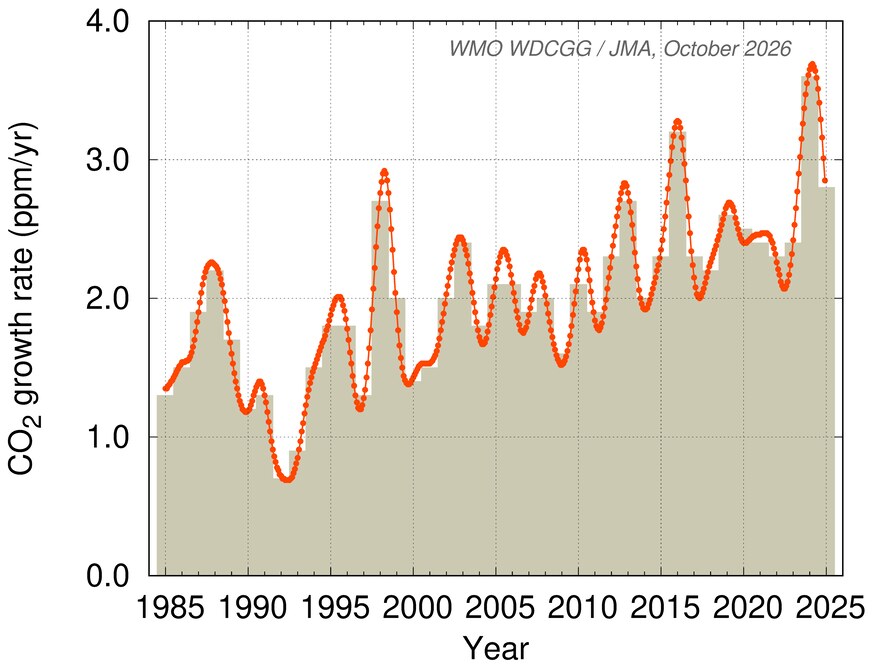
The World Meteorological Organization's report on greenhouse gases in the air in 2025, when carbon dioxide averaged 426.8 ppm and methane and nitrous oxide also reached new highs.
Tags: carbon dioxide, methane, nitrous oxide, greenhouse gases, Global Atmosphere Watch, station observations, global