Observations
Measured changes in climate, water and the living world: what was observed, how, and what a model of a place would have to reproduce.
A model of a place is only as good as what it has been checked against. The entries here are findings that something in the world has changed, by a stated amount, against a stated baseline: rivers that fell, forests that died back, a sea that emptied. They are kept for what a model can do with them, which is one of three things.
- A target. The finding gives a number a model should be able to reproduce, such as the size of a decline over a period.
- A relationship. The finding ties one quantity to another, such as warm seas to failed rains, and a model of the place has to carry that link.
- A threshold. The finding places a limit beyond which a system behaves differently.
A finding with none of these is news, and the News shelf lists it by date. The measurements that are taken continuously are on Vitals, which redraws nine global series at every build. Problems in one named place that a model could take on are Scenarios. The page on tipping points covers thresholds as a subject.
The shelf gathers entries by one tag and moves none of them. Each says what was measured, with what data, and what was not read.
2026
A 2026 paper in Science finds streamflow and surface water fell together across the world in 2023 and 2024, the largest drop since 1991, with South America accounting for about 70 per cent of the lost flow.
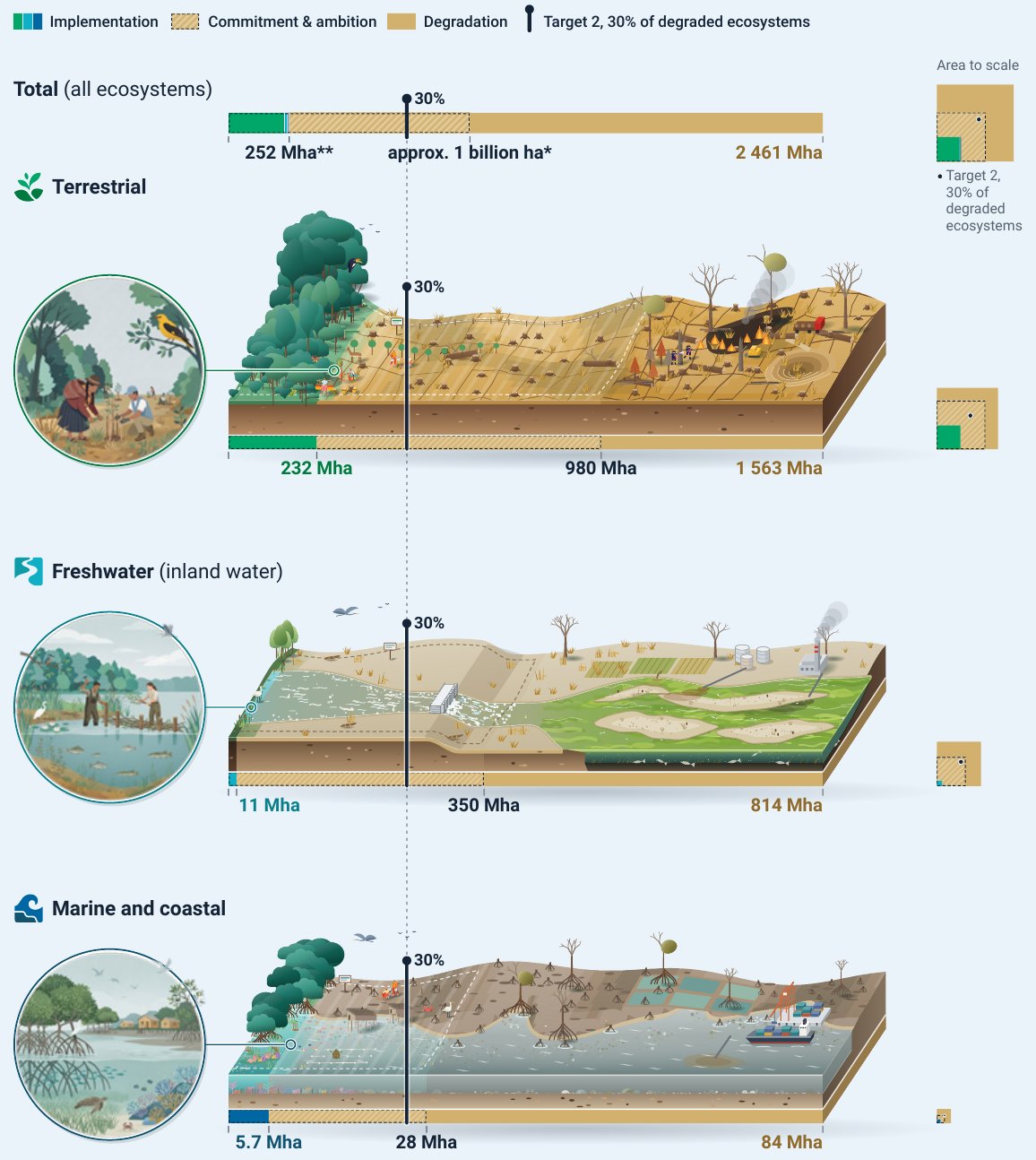
FAO, UNEP and the CBD Secretariat's 2026 count of restoration worldwide: 252 million hectares in 149 countries, mostly on land, against the commitments, the 30 per cent target and the money needed.
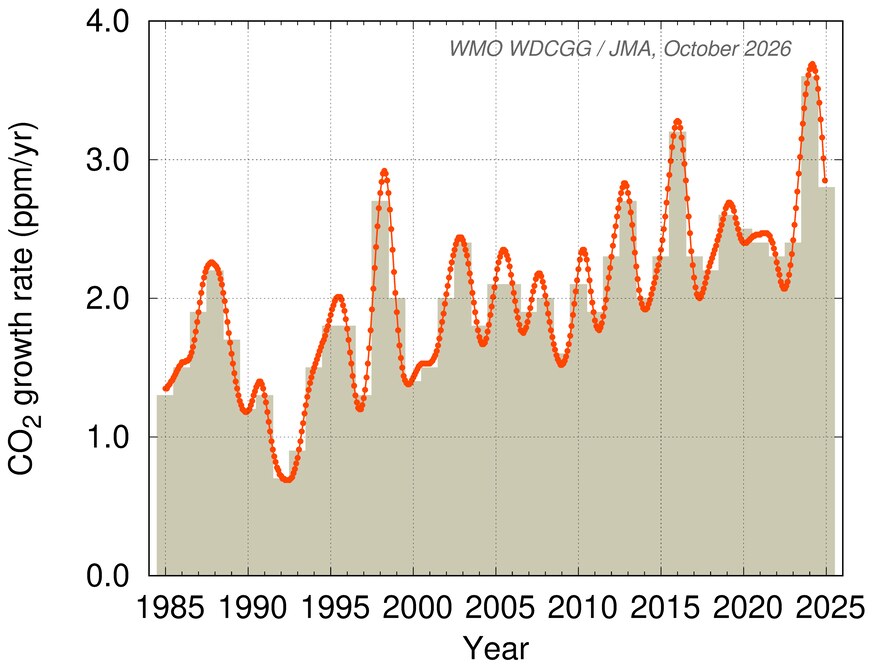
The World Meteorological Organization's report on greenhouse gases in the air in 2025, when carbon dioxide averaged 426.8 ppm and methane and nitrous oxide also reached new highs.
-
PNAS study, October 2026: thirteen years of nets, echosounders and genetics in the Gulf of Mexico found fish, krill and squid down 60 to 85% after the Deepwater Horizon spill, with no recovery.
WaterLiving systems open data

Annual update of sixteen planetary vital signs by William Ripple, Christopher Wolf and colleagues in BioScience; in 2026 seven of the sixteen are at record extremes.
 A 73% average decline in wildlife populations: an overview of the 2026 Living Planet Index report article draft
Hannah Ritchie at Our World in Data on what the headline figure of the 2026 Living Planet Index measures, and on the wildlife populations behind its average.
- Mapping coastal forest retreat using convolutional neural networks and different satellite imagery article draft
A 2026 PLOS One paper that uses convolutional neural networks on Landsat and Sentinel-2 imagery to map 37 years of forest loss to ghost forest and marsh on the North Carolina coastal plain.
- Tropical forests are facing increasing risks of exposure to critical temperature thresholds article draft
PNAS study, July 2026, from EPFL: satellite canopy temperatures and range maps for 208 tropical tree species show forests nearing the critical temperature for photosynthesis.
-
Paper in Science Advances, led by Climate Central, estimating how much of the rise in extreme water levels at 519 tide gauges worldwide is due to human-caused sea level rise.
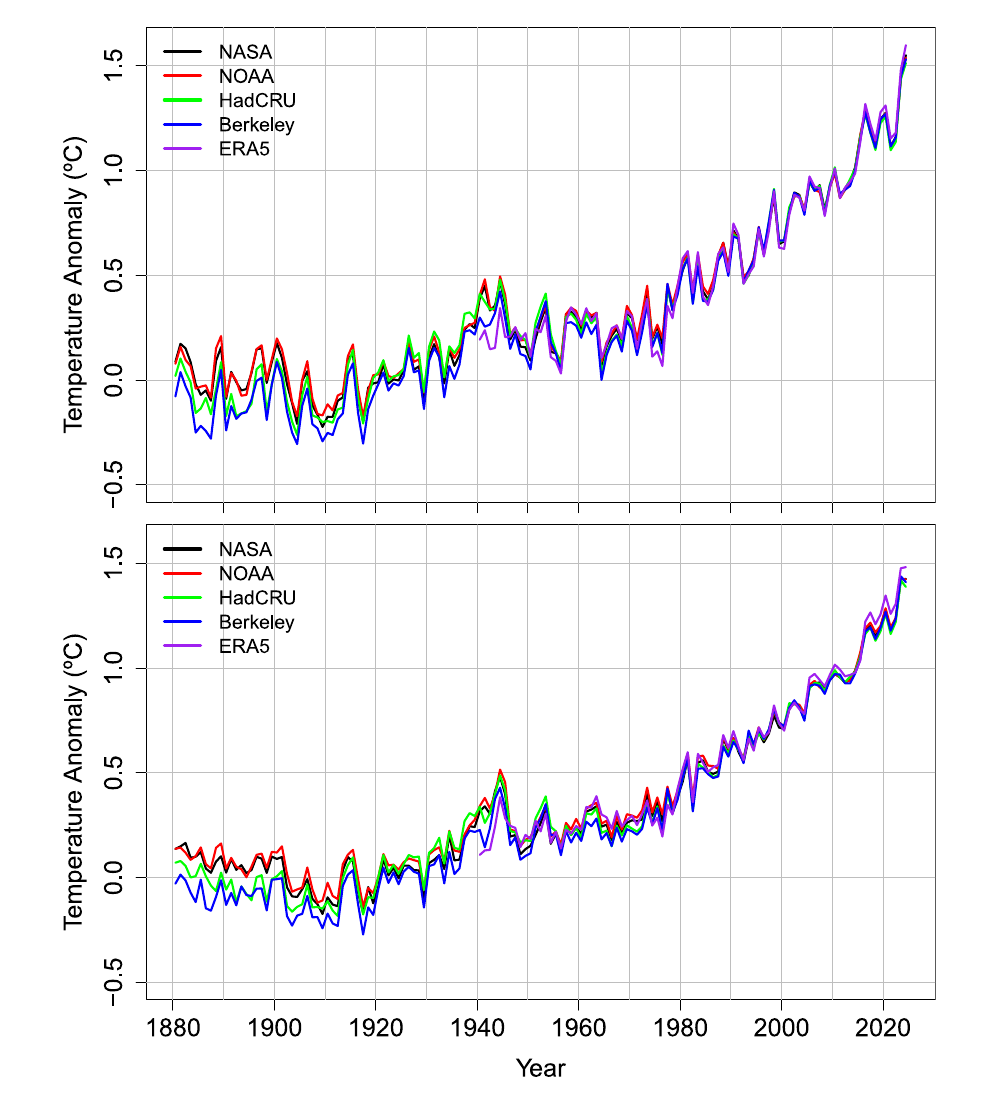
Grant Foster and Stefan Rahmstorf take the estimated effect of El Niño, volcanoes and the sun out of five global temperature records; what is left shows warming speeding up since about 2015.
2025

Tree rings from more than 1,800 fire-scar sites show that even 2020, a record year, burned only the historical average share of forest, and that what is unprecedented is how severely it burns.
-
Satellite proxies for productivity, water, temperature and connectivity, compared inside and outside 119 UNESCO biosphere reserves: only 18 scored higher on all of them inside.